


Some of the most valuable data in a manufacturing plant is also the hardest to reach. It sits inside OPC DA (Classic) servers: years of temperatures, pressures, run states, and counts from equipment that still runs the process every day. That operational data is exactly what modern analytics, cloud platforms, and Industrial AI depend on. Models are only as good as the data feeding them, and when a large share of the plant floor is locked behind a legacy protocol, that data never reaches the systems that could act on it. The result is a partial picture: analytics with blind spots and AI initiatives starved of the ground truth they need.
Today we're launching Litmus OPC Fusion, a free tool that closes that gap and brings your trapped legacy data into the modern world.
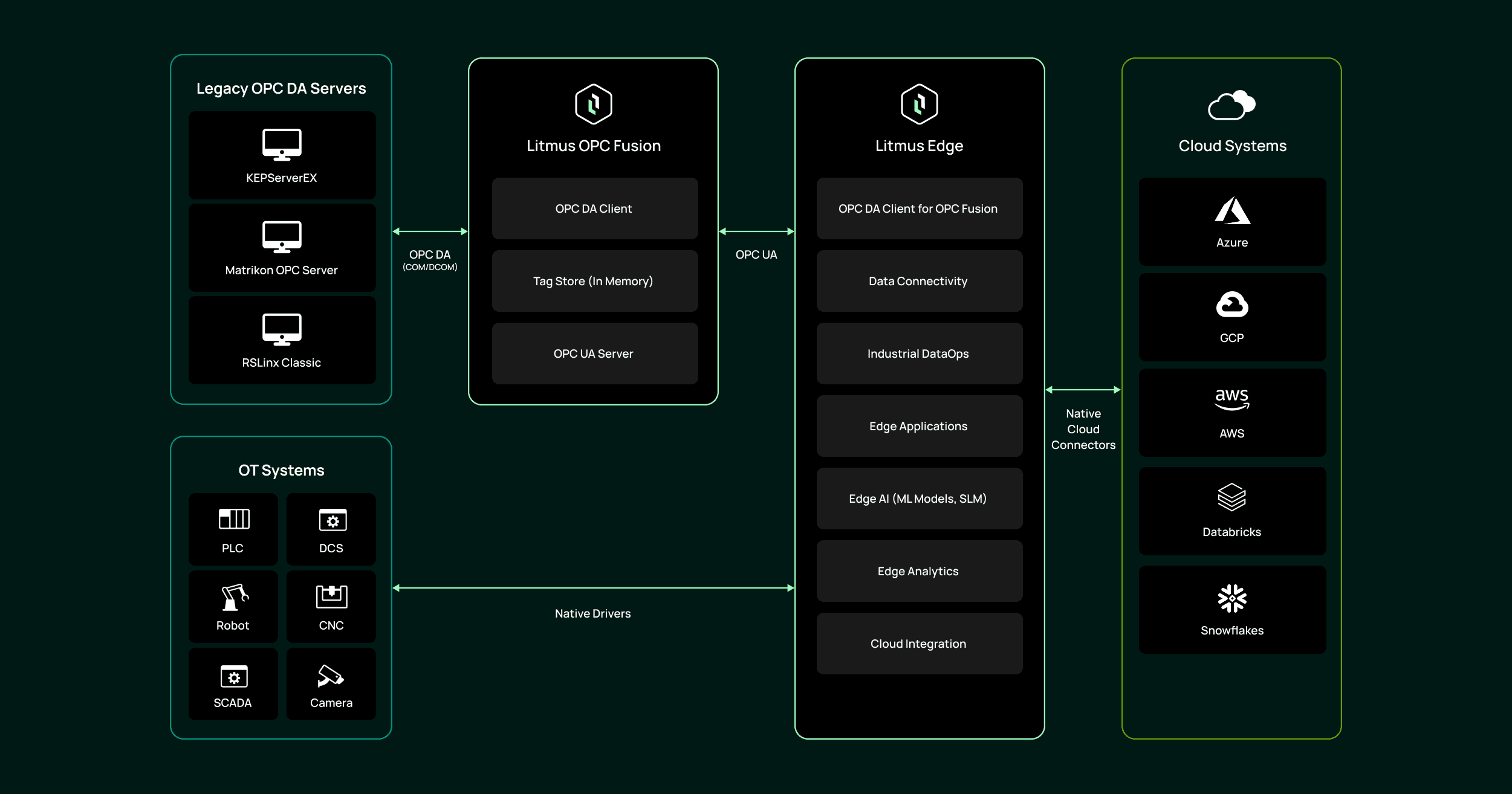
OPC Fusion is a Windows-based bridge that connects legacy OPC DA systems to modern data architectures. It reads data from your existing OPC DA servers and republishes it as OPC UA, with no changes to the servers you already run. Its primary job is to feed Litmus Edge, bringing legacy data into the Litmus Industrial Data Foundation for contextualization, analytics, Industrial AI, and cloud integration. More broadly, because it exposes a standard OPC UA server, OPC Fusion works as a general-purpose way to lift data out of trapped legacy systems and move it toward any modern, OPC UA-based data pipeline. It is free, complementary to the Litmus platform, and fully backed by Litmus.
OPC DA is still in use across a large base of brownfield plants. It's dependable, it's deeply embedded in existing processes, and most teams have good reason not to touch it. The "if it works, leave it alone" instinct is sound when the equipment is running production.
The challenge is that OPC DA is built on Windows COM/DCOM, which makes the data awkward to reach securely and remotely, and keeps it isolated from modern OT-IT data flows. So OT-IT teams face a familiar trade-off: disrupt working infrastructure to modernize it, or accept that a meaningful slice of operational data stays stranded and invisible to the platforms driving analytics and AI.
In short:
Valuable data, locked in: Years of operational history sit inside OPC DA servers.
Modern tools can't reach it: COM/DCOM keeps that data off the OT-IT data flow.
Ripping it out is risky: Stable production equipment is best left running.
AI and analytics pay the price: Missing data means blind spots and weaker models.
OPC Fusion gives you a third path. It sits alongside your existing servers, reads their data, and republishes it in a modern, secure form, while the legacy servers stay exactly as they are. The data your analytics and AI projects have been missing becomes available, without a forklift upgrade.
OPC Fusion is built for OT-IT integration teams, technical architects, and solution designers who need legacy data in a modern platform. Its core capabilities:
Bidirectional conversion: Pull data in by converting OPC DA to OPC UA, and write back by converting OPC UA to OPC DA. You can read from legacy systems and push values back down to them.
High tag throughput: Validated for high-density tag environments.
Remote OPC DA server support: Connect to OPC DA servers on adjacent machines across your network, not just the local host. Many alternative converters advise against remote use; OPC Fusion supports it.
Broad Windows compatibility: Runs on Windows from XP SP3 through Windows 11 and Windows Server 2025, in both 32-bit and 64-bit.
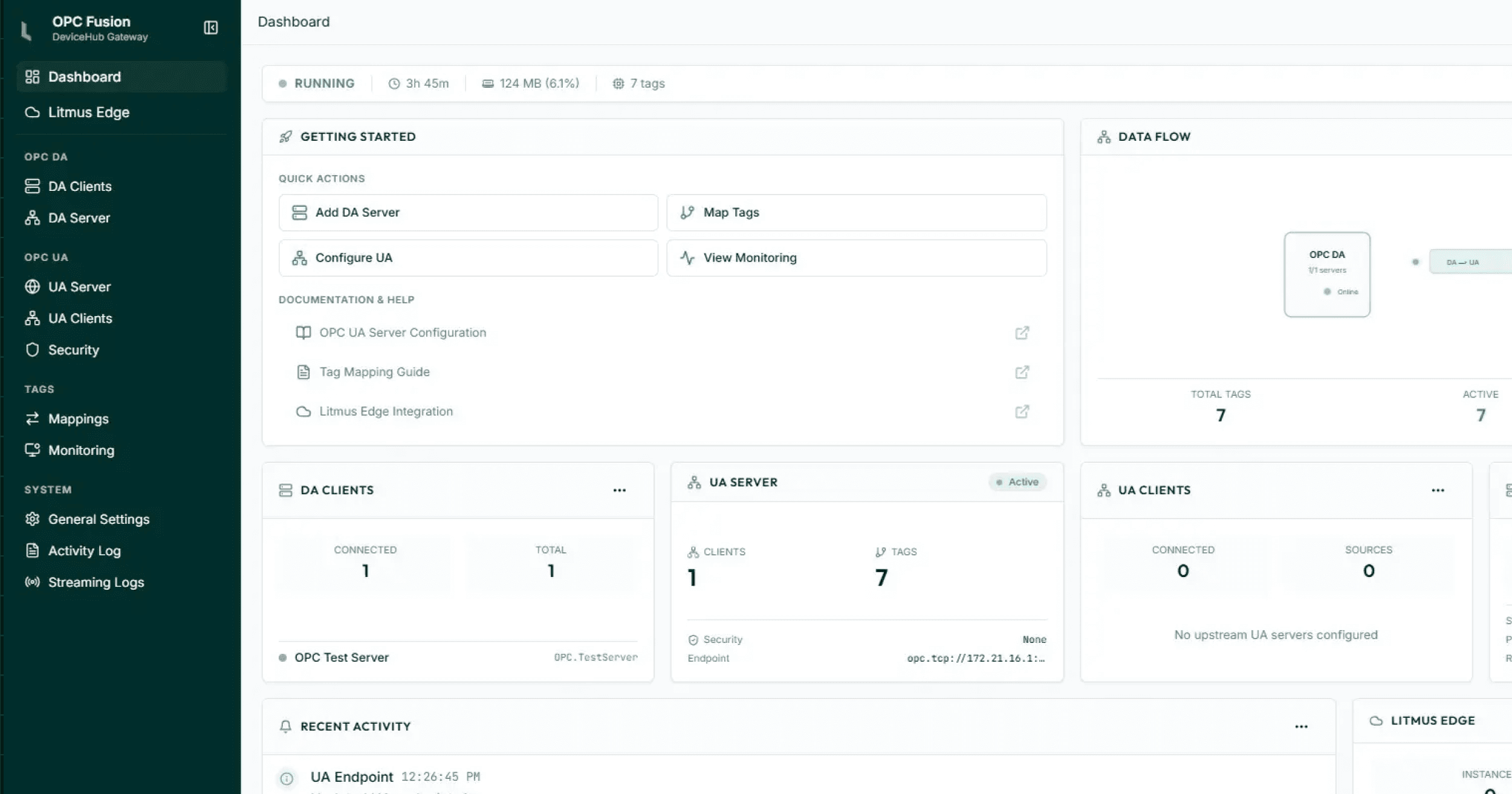
Browser-based configuration: Configure and monitor everything from a modern web UI. The service runs where your OPC DA server lives, and you administer it from anywhere on the network.
Secure by design: OPC UA Sign and SignAndEncrypt security modes, certificate management, and a trust-list workflow for connecting clients.
Getting the data out of a legacy server is only the first step. The real value comes from where that data goes next.
Once legacy OPC DA data lands in Litmus Edge through the OPC UA Client Advanced driver in DeviceHub, it enters the Litmus Industrial Data Foundation: the same platform that already connects modern PLCs, historians, sensors, and IT systems. Legacy and modern data sit side by side, structured and ready to use:
DataOps: Normalize and contextualize the raw tags, attach asset metadata and relationships, and organize everything with reusable data models for machines, lines, and plants.
Edge storage and analytics: Store and query history locally in DataHub, and run no-code streaming analytics and KPIs against live operational data.
Edge AI: Apply ML models and AI workflows to equipment data at the source, turning decades-old assets into inputs for prediction, classification, and anomaly detection.
Cloud and enterprise integration: Route trusted operational data northbound to AWS, Azure, and GCP, or share it in real time across OT and IT through a Unified Namespace.
This is what sets OPC Fusion apart from a standalone DA-to-UA converter. A point converter gives you a protocol translation and stops there. OPC Fusion connects trapped legacy data to a full data foundation, one that can combine it with modern historians and relational sources, model it, and push it all the way through to analytics, AI, and the cloud. Litmus becomes the layer where legacy operations and modern industrial data finally live together.
Point OPC Fusion at your OPC DA server, map the tags you want, and connect Litmus Edge to the OPC UA endpoint. From there, your legacy data flows straight into the platform.
Full installation, tag-mapping, and security instructions are in the documentation: https://docs.litmus.io/solutions/litmus-opc-fusion
OPC Fusion is available for free through the Litmus Central Portal: Litmus Central Portal It's a complementary addition to the Litmus platform: free to use, but fully backed by the standard Litmus release cycle, support SLA, and bug-fix commitments. This is not a community-maintained or single-purpose vendor tool with an uncertain future. It's part of the Litmus suite and supported like every other part of it.
OPC DA is embedded in countless working plants, and replacing stable equipment carries real risk. But its reliance on Windows COM/DCOM keeps that data isolated from modern analytics, cloud, and AI pipelines. OPC Fusion bridges it forward without disrupting the systems in place.
OPC Fusion exposes a standard OPC UA server, so any compliant OPC UA client can connect. Its primary purpose is to feed Litmus Edge, where the data connects to DataOps, analytics, Edge AI, and cloud integration.
Yes. OPC Fusion is free through the Litmus Central Portal and fully backed by standard Litmus support.
Yes. OPC Fusion supports remote OPC DA connectivity across your network, with the appropriate DCOM configuration in place.
If you have OPC DA systems holding data your analytics and AI projects need, OPC Fusion is the shortest route to unlocking it, without touching the servers you depend on. Get OPC Fusion from the Litmus Central Portal, and see the documentation for full setup guidance.