


Collecting industrial data is rarely the hard part anymore. Explaining it is. Which machine does this tag come from? Which line, which site? What does the value mean? Today, every team downstream answers those questions again, from the architect building the Unified Namespace to the data scientist training a model.
Litmus Edge 4.4.0 answers them once, at the edge, so your data arrives contextualized: organized by your asset hierarchy before it leaves the plant. That context makes it ready for AI, with the models that use it managed in one place next to the machine. It's also shared across your enterprise through Litmus Unify, on a path between network layers that's ready for production. And more of your equipment can now feed that flow. As our latest long-term support (LTS) release, 4.4.0 is also a stable version to standardize on across your sites.
Version 4.4.0 doesn't change how Litmus Edge works. It deepens the capabilities you already rely on, from modeling your assets to running AI next to the machine. Here's what each area gains.
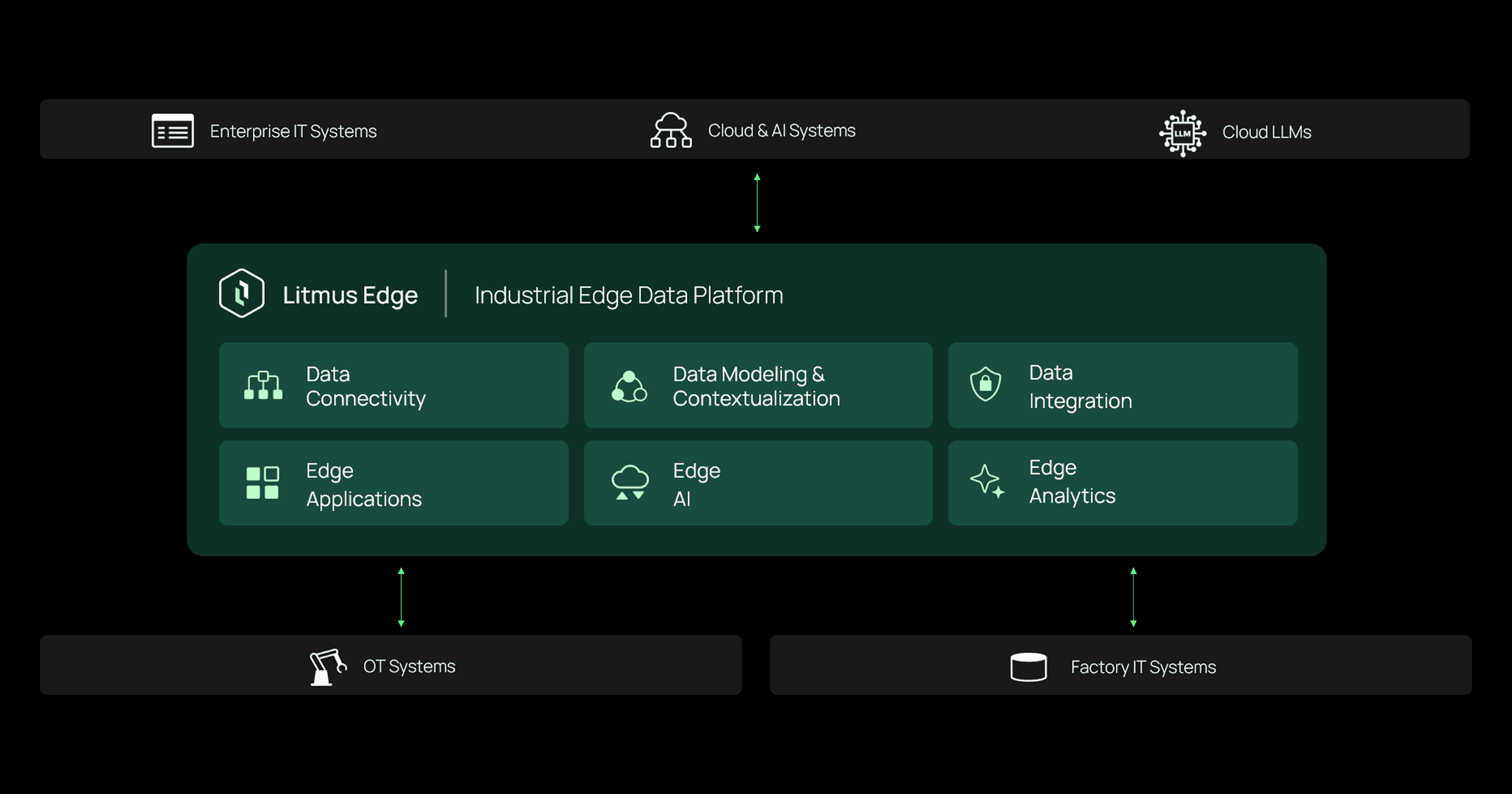
Digital Twins have long been how Litmus Edge turns raw tags into structured, trusted data. In 4.4.0, they carry more of the context your consumers need.
A Unified Namespace only works when every site describes its assets the same way. When that structure lives inside each integration, it drifts plant by plant, and someone ends up reconciling it later. Litmus Edge 4.4.0 keeps the structure in the asset model, where you define it once.
Digital Twins can now carry each asset's hierarchy path and static metadata. That's the enterprise, site, area, line and machine a value belongs to, along with the descriptive attributes your consumers need. Every message from the twin brings that context with it. Your analytics and AI teams can compare a filler in one plant with a filler in another, without a mapping spreadsheet.
Digital Twins also gives static attributes, dynamic attributes and flattened payloads their own topics. Each consumer subscribes with wildcards to only what it needs, instead of filtering payloads it never wanted.
Litmus Edge already runs analytics flows and AI models where the data is created, with optional round trip to the cloud. Version 4.4.0 makes that work easier to manage as it grows.
Context is what makes industrial data ready for AI. A model that knows which machine, line and site a value came from is one you can trust with real decisions.
But once Industrial AI moves into daily operations, the models multiply. One team connects a language model to summarize alarms. Another runs a TensorFlow model to flag early signs of pump failure. When those live in different places, nobody has the full picture of what's running where.
Litmus Edge 4.4.0 brings them together in the AI Suite. A single AI Suite page replaces the separate model page in Analytics. The section that used to be called Connections is now named AI, and it holds your connections to AI model providers. A new TensorFlow section lets you manage tensor models alongside them.
Your team gets one place to see and govern every AI resource on an edge node. A trained model also has a shorter path to inference right beside the machine, which is where the decision has to happen.
Litmus Edge already delivers data to cloud platforms, databases and message brokers. But context only creates value when the rest of the business can use it, so 4.4 adds two more ways to share contextualized data beyond the edge node: a direct path into your Unified Namespace, and a production-ready path across network layers.
The new Litmus Unify Connector is where the context you built into your models pays off. It publishes data from Litmus Edge to Litmus Unify, and it builds the topics from each asset's hierarchy path and metadata. Every site publishes into the same structure automatically. Your namespace stays consistent as you add lines and plants, and nobody has to map topics by hand, site after site.
The connector supports MQTT, MQTTS, WebSocket and secure WebSocket, so it fits the network and security rules you already have. You activate it with a Litmus Unify activation token. It also runs alongside the existing Litmus Unify connector, so current integrations keep working while you make the move.
Edge Cascading: Many plants keep the control network separate from the enterprise network, often with a DMZ in between. Edge Cascading links Litmus Edge instances so data can move from a node on the plant floor to a node in the DMZ or at site level, and from there to enterprise and cloud systems.
Context, sharing and AI all start with getting the data in, and Litmus Edge already connects to a wide range of PLCs, controllers and industrial systems out of the box. Every asset you can't connect is a gap, and it's usually the awkward ones, the specialty controller or the old serial device, that hold a project back. Litmus Edge 4.4 closes many of them.
Call OPC UA methods, not only read tags: Most OPC UA connections read and write tags. But many OPC UA servers also expose methods, which are functions on the machine such as starting a job, resetting a counter or loading a recipe. The OPC UA Advanced Client driver in Litmus Edge 4.4.0 can now call those methods. Litmus Edge moves from observer to participant. When your data shows that something on the line needs to change, you can trigger the action from the same platform, with no extra middleware in between.
Capture every tightening from MTF 6000 controllers: Atlas Copco MicroTorque MTF 6000 controllers handle low-torque fastening in assembly work such as electronics and medical devices, where every screw can end up in a quality record. These controllers don't support MID 61, the Open Protocol message most drivers rely on for tightening results, so their data often goes uncollected.
In 4.4.0, the Open Protocol driver reads Last Tightening Results (MID 1201 and 1202) with dynamic PIDs you can browse. It also adds Generic Subscribe (MID 8), connection result data (MID 2) and read-time polling (MID 80 and 81). You get a complete, timestamped record of each tightening, ready for traceability, audits and SPC.
Serial drivers rebuilt on Gen2: Plenty of valuable equipment still talks over serial lines. In 4.4.0, the serial drivers move from Gen1.3 to the Gen2 driver architecture, with full parity for register and data-type reads and writes. Both generations run side by side, so you can move each connection when it suits your schedule instead of in one big cutover.
Beyond the headline features, Litmus Edge 4.4 includes improvements throughout Analytics, DeviceHub, Digital Twins, Integration and the OPC UA server. You'll find the full list in the release notes.
Litmus Edge 4.4 is the latest release of Litmus Edge, the industrial edge data platform from Litmus. It adds richer asset context, more ways to share data, and an easier path to AI at the edge.
Litmus Edge 4.4 adds asset hierarchy context to Digital Twins, a new Litmus Unify Connector, a production-ready Edge Cascading v2 and a single AI Suite for your AI models. It also adds OPC UA Methods, MTF 6000 torque controller support and serial drivers rebuilt on Gen2.
Every Digital Twins message now carries its asset context, so AI models know which machine, line and site the data comes from. The AI Suite keeps your AI models in one place on the edge node, right next to the machine.
You can download Litmus Edge 4.4.0 from Litmus Central. https://portal.litmus.io/
Litmus Edge 4.4 is available now. Whether you’re building a Unified Namespace, scaling Industrial AI or connecting more of your plant, it gives your team richer context and a simpler path from the machine to the enterprise.
Book a demo to see what Litmus Edge 4.4.0 can do for your operations.