


For years, industrial transformation followed a fairly predictable logic. Modernize operations. Improve visibility. Centralize data. Push more information upward into cloud systems where it could finally be analyzed at scale. And to be fair, a lot of that effort worked. Manufacturers became dramatically more connected over the last decade. Plants generated more telemetry than ever before. Dashboards multiplied. Data historians expanded. Entire organizations invested heavily in bridging the gap between operational systems and enterprise infrastructure.
But somewhere along the way, the industry started confusing data movement with operational intelligence. That distinction matters now, more than it used to because AI changed the pressure on industrial systems almost overnight.
Suddenly, manufacturers weren’t just trying to collect data anymore. They were trying to operationalize intelligence across facilities, production lines, workflows, and teams that had evolved independently for decades. Different naming conventions. Different infrastructure generations. Different operational habits. Sometimes different philosophies entirely.
And that’s where many Industrial AI initiatives begin to stall. Not during the pilot phase—that’ usually the easy part. The friction shows up later and quietly at first. A predictive maintenance model works in one facility but behaves unpredictably in another. A quality initiative depends on contextual data that only exists in spreadsheets maintained by a single site engineer. Operators stop trusting centralized systems because latency interferes with live production visibility. A cloud dashboard says one thing while the plant floor says another.
Eventually, organizations realize they do not have an AI problem. They have an architecture problem. That realization is reshaping industrial strategy right now, underneath almost every serious conversation around Industrial AI scale. Because the manufacturers moving beyond isolated AI wins tend to share something in common: A layered industrial data architecture designed for operational consistency—not just connectivity.
Not every company structures it the same way. The terminology varies. The tooling varies. But the pattern itself keeps resurfacing. These six foundational layers collectively form what Litmus calls the Industrial Data Foundation, or the operational foundation beneath scalable Industrial AI that solves different constraint modern industrial systems are now running into.
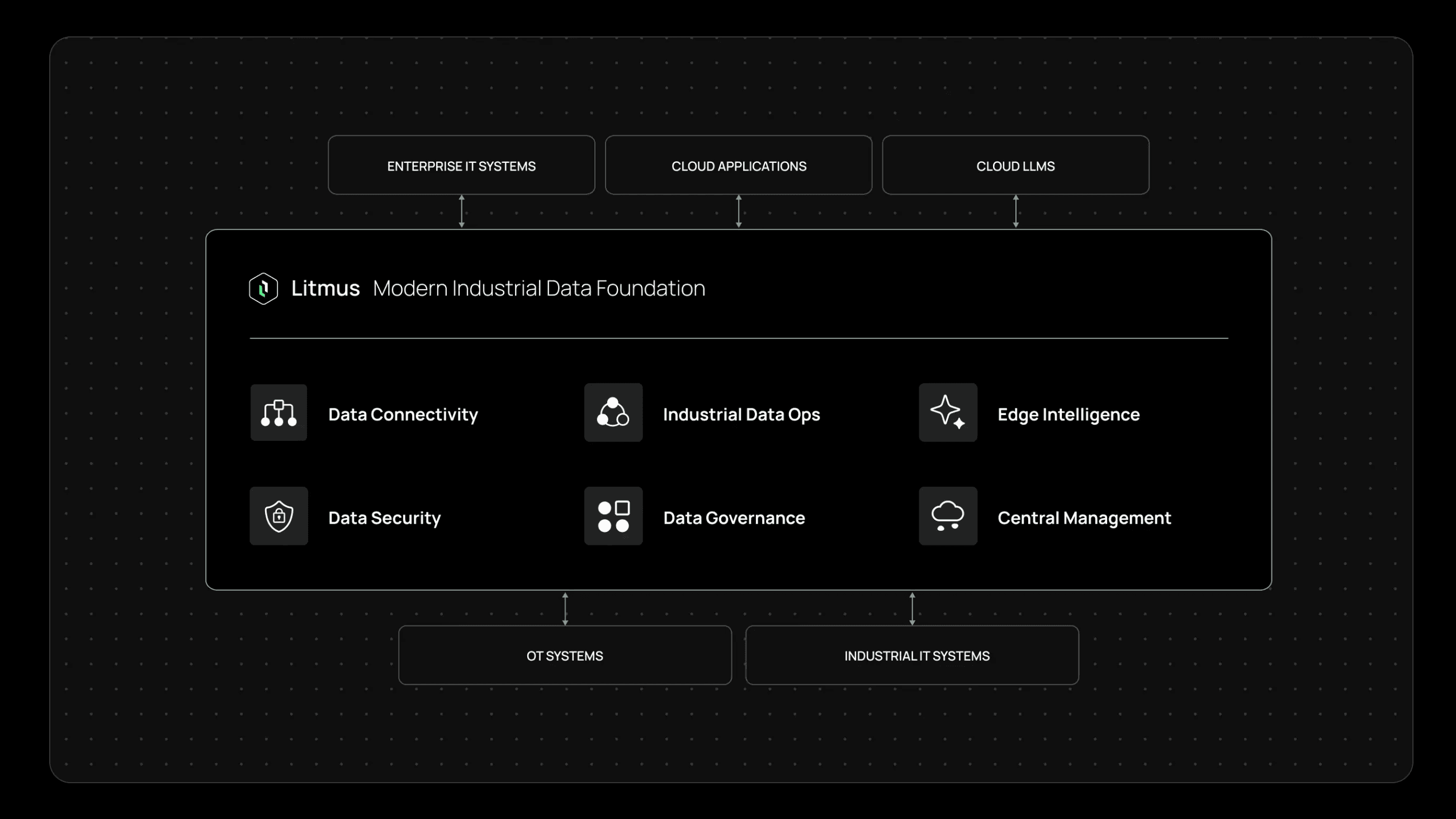
Connectivity used to feel like the breakthrough. For decades, industrial data lived inside systems that were never designed to communicate cleanly outside the plant floor. PLCs. SCADA systems. Historians. OEM equipment. MES environments layered on top of infrastructure that often evolved site by site, year by year, acquisition by acquisition.
So manufacturers focused on access. Get the data out. Standardize protocols. Centralize visibility. Build pipelines into cloud environments where information could finally move more freely across the organization. That was necessary. Still is. But connectivity, by itself, does not create operational intelligence. In many cases, it simply relocates fragmentation somewhere else. What began as a challenge of industrial data connectivity has evolved into something much larger.
A machine tag without operational context is still ambiguous. So is a pressure reading disconnected from asset hierarchy or production state. And AI models built on inconsistent plant data rarely survive replication beyond the environment they were trained in.
This is the shift many organizations are confronting now: The challenge is no longer whether industrial data can move. It’s whether industrial data can behave consistently enough to support intelligence at scale. Connectivity matters enormously, but modern industrial architecture cannot stop there. Not anymore.
Most Industrial AI initiatives don’t collapse because the model fails. They collapse because the surrounding operational environment was never standardized enough to support replication. That distinction is becoming painfully clear inside manufacturing organizations.
One facility names assets one way. Another inherited entirely different structures after an acquisition years ago. A third still depends on tribal operational knowledge that was never formally encoded anywhere at all. The result is subtle at first. Teams spend more time reconciling operational context than deploying intelligence. AI projects become heavily customized site by site. Scaling turns into a long series of exceptions.
This is where Industrial DataOps enters the picture—not as a buzzword, but as a practical response to operational inconsistency. Normalization. Contextualization. Semantic modeling. Unified namespace architectures. Data orchestration. None of these capabilities are particularly flashy. Which may be part of the reason they were underprioritized for so long.
But manufacturers are beginning to realize something important: AI does not scale cleanly on fragmented operational semantics. Eventually, the companies that move fastest will not be the ones experimenting with the most AI use cases. They’ll be the ones that solved contextual consistency first.
For years, industrial architecture conversations revolved around centralization. Move data upward. Aggregate it centrally. Analyze it later. But manufacturing environments do not operate in abstract infrastructure diagrams. They operate in real time. Sometimes brutally so.
A quality anomaly cannot wait several seconds for a response loop through remote infrastructure. Operators cannot lose production visibility because connectivity between systems becomes unstable. Safety systems cannot depend entirely on cloud availability during live operations.
Eventually, physical systems force the architecture conversation back toward physical realities. Which is exactly why the edge has become strategically important again. Not because manufacturers are abandoning cloud infrastructure. Far from it.
The shift is happening because operational intelligence increasingly needs to exist closer to operations themselves. Edge intelligence—inference, context, and analytics at the edge. Even orchestration decisions moving closer to production environments instead of existing entirely above them.
The manufacturers preparing seriously for autonomous operations already understand this. Quietly, many are redesigning architectures around distributed intelligence models now—before scale forces the issue later. Because factories do not operate on PowerPoint timelines. They operate on milliseconds. Throughput. Downtime. Physics. And physics tends to win architectural arguments eventually.
There’s a version of digital transformation where governance remains mostly procedural. Important, yes. But secondary. Something organizations promise to tighten later once innovation moves faster.
Industrial AI changes that calculation very quickly. Because once intelligence starts influencing operational decisions—even partially—ambiguity becomes dangerous. Now teams need to know where data originated. Whether it was transformed. Which operational model is authoritative. Why a recommendation was generated. Whether production environments across facilities are even evaluating conditions consistently in the first place.
Without governance, trust erodes fast. And manufacturing environments are unusually sensitive to trust breakdowns. Operators and engineers do not adopt systems because they are technically impressive. They adopt systems that behave predictably under operational pressure.
That distinction matters more than many executives realize. Which is why governance is evolving into something much larger than compliance infrastructure. It is becoming operational credibility infrastructure. Data lineage. Metadata visibility. Semantic consistency. Ownership models. Policy enforcement. Not because governance suddenly became fashionable but because Industrial AI raises the cost of ambiguity.
Industrial environments were already difficult to secure before AI entered the equation. Legacy systems. Segmented networks. Air-gapped facilities. Infrastructure that cannot simply be rebooted whenever convenient. Operational downtime with physical consequences attached to it.
Now layer distributed intelligence systems on top of that complexity. Edge workloads. Model deployment pipelines. Cross-site orchestration. Real-time operational access spanning cloud and plant environments simultaneously. The attack surface changes completely.
But more importantly, the architecture requirements change. Security can no longer exist downstream from Industrial AI strategy. It cannot be treated as a separate conversation that happens after deployment decisions are already made. Because resilience itself is now part of operational architecture. The system has to assume interruptions. Connectivity instability. Imperfect environments. Infrastructure constraints. It has to continue functioning safely under operational pressure—not just ideal conditions.
Frankly, this is one of the biggest mindset shifts happening across industrial organizations right now. AI systems are forcing companies to think about operational resilience and intelligence as part of the same architectural conversation.
Most manufacturers can modernize a single site. That’s no longer the difficult part. What is—is maintaining operational consistency across dozens of facilities without recreating fragmentation all over again. Different deployment versions emerge. Configurations drift. Sites begin customizing independently. Governance weakens over time. What started as a unified architecture slowly fractures beneath growth.
This happens constantly. In fact, many organizations discover that scale itself becomes the real architecture stress test long before the technology reaches its actual limits. That’s why centralized management has become the final critical layer in modern industrial architecture.
As Industrial AI deployments expand across sites, manufacturers need a way to govern infrastructure remotely, deploy models consistently, standardize operational templates, monitor environments at scale, and replicate what works without rebuilding every implementation from scratch. Platforms like Litmus Edge Manager provide the centralized control plane needed to bring consistency, governance, and repeatability to multi-site operations.
Because eventually the conversation changes. At first, manufacturers ask: “ Can we deploy Industrial AI?” Then later, the more thoughtful question emerges:”Can we operate it consistently across the enterprise without losing control of the architecture underneath it?
Over the next decade, most manufacturers will gain access to powerful AI technologies. Models will improve. Tooling will mature. Infrastructure costs will continue shifting. That part is inevitable. The separation happening in manufacturing has less to do with who adopts AI first and far more to do with who builds the operational foundation capable of sustaining it.
Some organizations are already building architectures designed for contextual consistency, distributed intelligence, governance, resilience, and repeatability across sites. Others are layering AI onto fragmented infrastructure and hoping standardization happens later.
Usually, it doesn’t. Because eventually models become accessible to everyone. Operational architecture does not. And the manufacturers building these six layers intentionally today are positioning themselves very differently for the industrial era that’s beginning to take shape now. Not louder or trendier. Just structurally ahead.