


Most maintenance work is scheduled on a calendar or kicked off only after something breaks. In many plants, the machine showed signs of trouble long before the work order went out, but that signal never reached the people who fix things. Litmus Edge now integrates directly with MaintainX, closing that gap so real equipment data drives the maintenance your team does.
The integration is a direct connection between your plant-floor data and your maintenance platform. Litmus Edge collects and standardizes data from your machines, and the connector sends that data straight into MaintainX, the AI-powered CMMS and enterprise asset management platform built for industrial and frontline teams. The result is work orders and asset records that reflect what your equipment is actually doing, rather than what a schedule assumes.
For maintenance and operations teams, this changes the role MaintainX plays. It stops being a system you update by hand after a walkaround and becomes one that responds to live conditions on the floor.
MaintainX already handles the hard parts of maintenance well. It manages work orders, preventive maintenance, parts inventory, asset history, and reporting that frontline teams actually use. What it cannot do on its own is see inside your machines in real time. That data lives in PLCs, sensors, and control systems on the OT network, which is exactly where Litmus Edge operates.
Without a connection between the two, teams tend to fall back on two imperfect habits:
Time-based maintenance, where assets are serviced on a fixed calendar whether they need it or not. You pay for work that was not required, and you still miss failures that happen between intervals.
Reactive maintenance, where the work order is created only after a breakdown. By then you are dealing with unplanned downtime, rush parts, and overtime.
Connecting Litmus Edge to MaintainX adds a third and better option: condition-based maintenance, where the equipment's own readings decide when action is needed.
The connector is built to run quietly in the background and surface maintenance only when it is warranted. Here is what it enables.
Stream live equipment readings into MaintainX. Runtime hours, cycle counts, temperature, pressure, vibration, or any value Litmus Edge already collects can flow into MaintainX as meter readings, continuously and automatically.
Trigger and update work orders from real conditions. When a reading crosses a threshold you care about, MaintainX can open or update a work order. Maintenance is created by the machine's actual state instead of a date on a calendar.
Keep assets and maintenance data in sync. The connector can create and update records in MaintainX, so your asset list and maintenance data stay aligned with what is really on the floor.
Build on standardized data, not raw tags. Because Litmus Edge normalizes and contextualizes data before it leaves the edge, the values arriving in MaintainX are clean, consistent, and tied to the right asset.
Consider a packaging line with a motor rated for a set number of running hours before it needs servicing. On a fixed preventive-maintenance schedule, a technician services that motor every month, sometimes too early and sometimes a week too late.
With Litmus Edge connected to MaintainX, the motor's runtime is streamed up as a meter reading as it accumulates. When the motor reaches its service threshold, a work order opens in MaintainX automatically, assigned to the right team with the correct asset history attached. The technician picks it up on the MaintainX , completes the work, and closes it out. No one had to remember to check a spreadsheet, and the motor was serviced based on how hard it actually worked.
Now extend that across the plant to compressors, pumps, conveyors, and CNC machines. Every asset generating data in Litmus Edge can drive its own maintenance in MaintainX. Teams move from guessing and reacting to planning around real equipment behavior, and that shift is where the reductions in unplanned downtime and wasted service visits come from.
The benefit also compounds over time. Every reading that flows into MaintainX builds a richer asset history, which gives the platform's AI and reporting real operating data to work with rather than only the records a technician remembered to log. Better inputs lead to better forecasts of when parts will wear out and which assets deserve attention first.
You do not need to write custom scripts or stand up middleware to make this happen. The flow is straightforward.
Litmus Edge connects to your equipment through its native connectivity to PLCs, sensors, historians, and control systems, then standardizes the incoming data.
You choose which values matter, selecting the tags, analytics outputs, or asset attributes you want reflected in maintenance.
The MaintainX connector sends that data into MaintainX as meter readings, or creates and updates records as conditions change.
MaintainX acts on it by opening work orders, updating assets, and surfacing insights to your frontline team.
Because the work of collecting, cleaning, and contextualizing OT data already happens in Litmus Edge, the integration itself stays light. You are connecting two systems that each do their job well, rather than forcing one to do the other's.
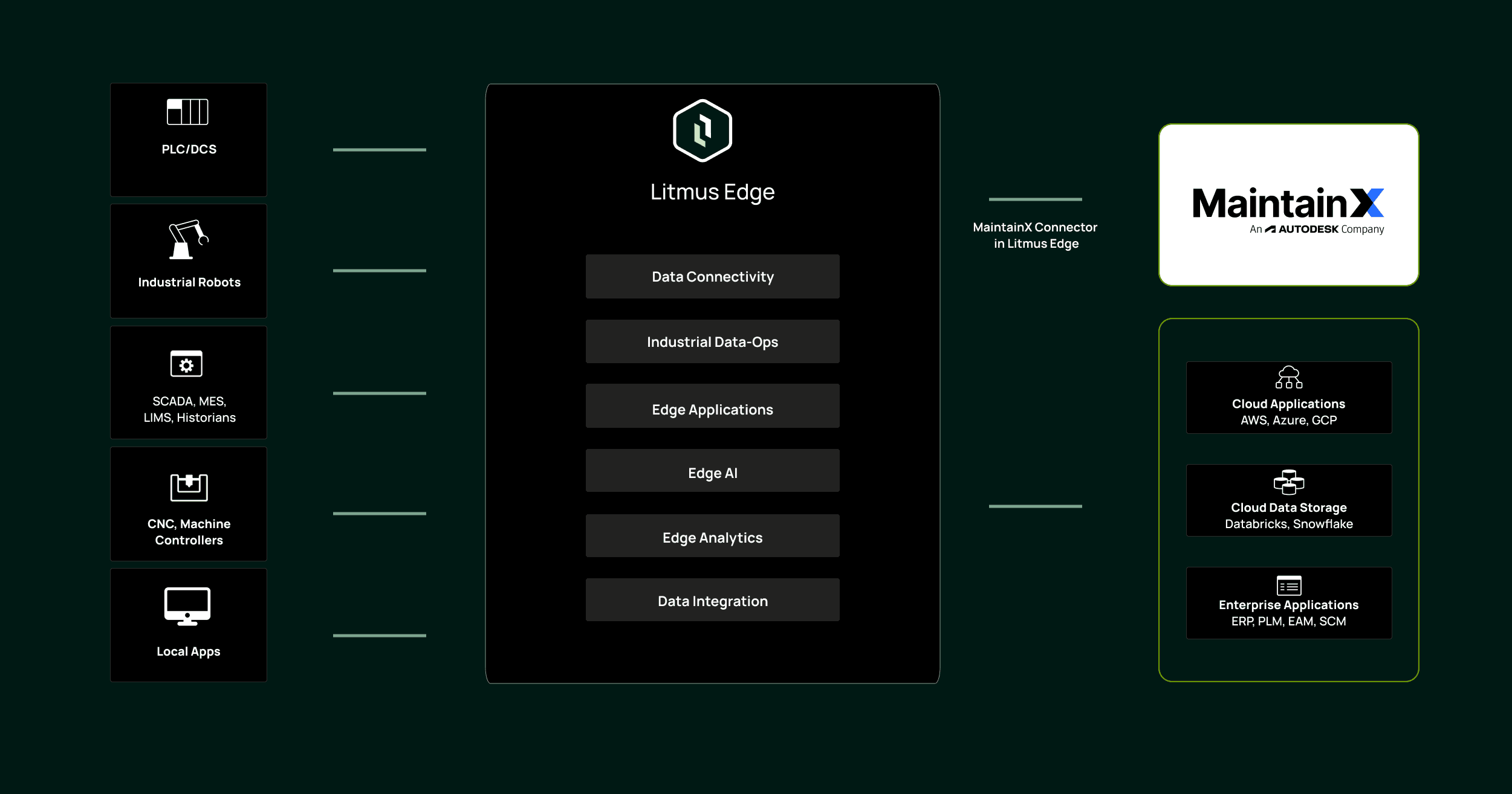
The MaintainX connector is one example of what Litmus Edge is built to do: take operational data that is trapped in machines and put it to work in the systems that run your business. The same data you send to MaintainX can also feed analytics, dashboards, a Unified Namespace, or cloud and enterprise applications, all without collecting it twice.
That matters because maintenance is not the only team that benefits from clean machine data. When Litmus Edge is the foundation, adding a new destination like MaintainX does not require a new integration project from scratch. It means routing data you already trust to one more place that needs it.
No. It complements it. You can keep time-based and usage-based maintenance in MaintainX and add condition-based triggers driven by live data from Litmus Edge. Most teams use both.
Any value Litmus Edge collects and standardizes. That includes meter-style readings such as runtime, cycles, temperature, or pressure, as well as events and conditions you define. These arrive in MaintainX as meter readings or record updates.
No. Litmus Edge connects to brownfield equipment and legacy control systems as readily as it connects to modern assets, so older machines can drive maintenance in MaintainX too.
The connector is configured inside Litmus Edge. If you are already collecting data from an asset, pointing that data at MaintainX is a configuration step rather than a development project.
Yes. Data collected in Litmus Edge can go to MaintainX and to your analytics, dashboards, Unified Namespace, or cloud systems at the same time. You connect and standardize the data once, then route it wherever needed.
The MaintainX connector is available in Litmus Edge. If you are already running Litmus Edge, you can begin sending equipment data to MaintainX and let real conditions drive your maintenance. If you are new to Litmus Edge, this is a clear, high-value place to start.
Request a demo to watch condition-based maintenance work at https://litmus.io/get-started