


Manufacturers don't struggle because they lack data. They struggle because every plant organizes that data differently. One site calls it "Line 3." Another calls it "Packaging Line." A third buries the same asset three folders deep under a controls engineer's naming convention. Individually, every site makes sense. Collectively, none of them do.
That's manageable until you try to compare performance across facilities, deploy a standardized application, or scale Industrial AI. Suddenly, inconsistent asset structures become the bottleneck. Industrial Asset Hierarchy Management in Litmus Edge Manager solves that problem by giving every site the same operational structure without forcing every site to rebuild from scratch.
Industrial Asset Hierarchy Management is a capability in Litmus Edge Manager for defining, standardizing, and governing the structure that organizes your assets—from the enterprise level all the way down to an individual work unit. It gives you reusable hierarchy templates, asset models, and instances so that every site describes its equipment the same way, and so analytics, applications, and Industrial AI all read from one consistent structure.
Think of it as the org chart for your operational data. Instead of each plant inventing its own layout, you define the levels once, apply them across facilities, and manage them from a single point of control.
Raw tags and edge devices, on their own, carry no organizational meaning. A temperature value from a PLC tells you a number—not which machine it came from, which line that machine belongs to, or which plant owns that line. Without a shared hierarchy, that context lives in tribal knowledge and spreadsheets, and it breaks the moment you scale past a single site.
A standardized asset hierarchy solves three recurring problems:
Cross-site comparison
You can’t benchmark performance when every site describes the same equipment differently. A standardized hierarchy that follows the same Enterprise → Site → Line → Machine structure makes KPIs comparable without manual reconciliation.
Industrial AI readiness
Models trained or deployed across plants need consistent inputs. A common hierarchy gives AI and analytics a predictable structure to reason over, instead of fragmented, site-specific layouts.
Schema drift control
As sites evolve, structures tend to diverge over time. Managing the hierarchy centrally keeps definitions aligned and reduces the drift that quietly corrupts multi-site reporting.
This is the same principle behind ISA-95 and the Unified Namespace: structure your operational data once, in a way that mirrors the physical reality of your operations, and everything downstream gets easier.
Litmus Edge Manager organizes the capability around three building blocks, all reached through the Asset Management area for each company.
Hierarchy templates define the levels that govern your asset structure. Litmus Edge Manager ships with standard templates and lets you adapt them to match how your organization actually works. The included ISA-95 standard template is a seven-level, industry-standard hierarchy.
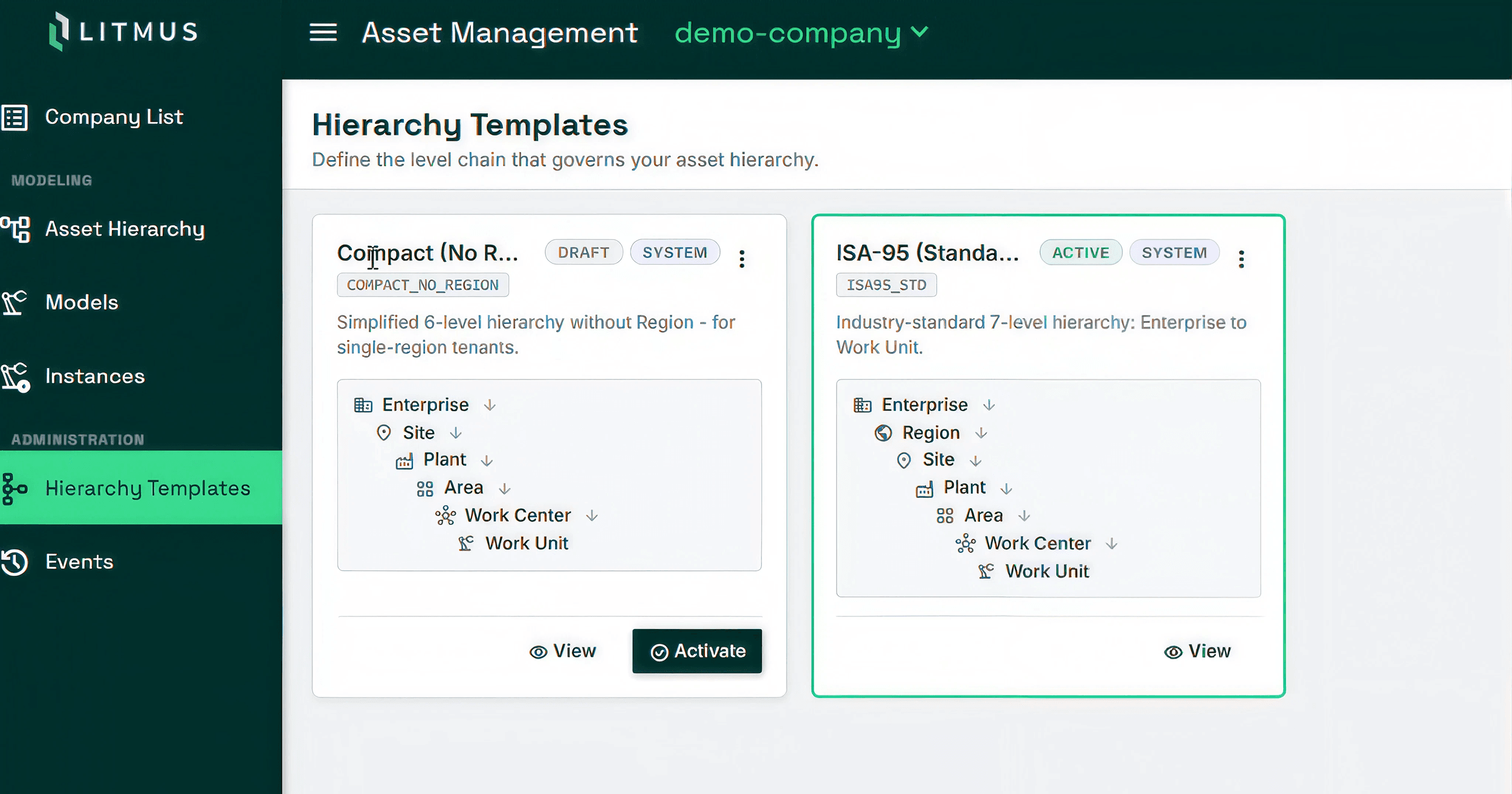
Asset Hierarchy Management Templates Not every organization needs all seven levels. A single-region manufacturer, for example, can use a compact template that drops the Region level entirely. Templates carry a clear lifecycle state—a template you're still designing stays in a DRAFT state, and the one governing your live structure is marked ACTIVE—so you can build and review a new structure before it takes effect.
Models are reusable templates for a class of asset. A model contains static attributes (fixed metadata like manufacturer, or location), dynamic attributes (live values mapped from tags), data transformations, and schemas. You build a model once for a CNC machine, a pump, or a packaging line, and reuse it wherever that equipment appears—the "build once, deploy everywhere" idea applied to asset definitions.
Instances are concrete assets created from a model. If the model describes "what a CNC machine looks like," an instance is this specific CNC machine on this line at this plant—placed at its correct position in the hierarchy and bound to the real tags feeding it. You can spin up many instances from a single model, each inheriting the same structure while carrying its own live data.
Together, these three turn a flat list of devices and tags into a structured, navigable representation of your operations.
A structured hierarchy isn't the end goal—it's the foundation for digital twins. A digital twin is a virtual representation of a physical asset that combines static metadata with real-time data into a single, structured payload.
Here's how the pieces connect. Litmus Edge ingests and normalizes raw data from PLCs, sensors, and machines at the source. The models and hierarchy you define in Litmus Edge Manager give that data its shape and context. Deployed together, they produce digital twins that emit contextualized, structured data—ready for northbound systems, analytics, and AI to consume without having to understand how the raw data was originally wired.
Managing this from Litmus Edge Manager means the structure stays governed centrally and consistent across every edge device, instead of being redefined site by site.
Getting from a flat device list to deployed digital twins follows a straightforward path:
- 1.
Open Asset Management for your company, and go to the Asset Hierarchy screen.
- 2.
Choose or customize a hierarchy template. Start from the ISA-95 standard seven-level template, or a compact variant, and adjust the levels to reflect your real structure.
- 3.
Activate the template so it governs your asset hierarchy.
- 4.
Build your models—define reusable models for each class of asset, with static attributes, dynamic attributes, transformations, and schemas.
- 5.
Create instances from your models, placing specific assets at the right levels in the hierarchy and binding them to their live tags.
- 6.
Deploy the resulting structure and digital twin models to your Litmus Edge instances, where they produce contextualized data at the edge.
Industrial Asset Hierarchy Management is the central-management layer for structure. Litmus Edge captures and contextualizes operational data at the source and runs the digital twins. Litmus Edge Manager standardizes and governs the hierarchy, models, and deployments across distributed sites. And the structure you define here aligns naturally with the ISA-95 hierarchy that organizes a Litmus Unified Namespace, so your asset structure and your real-time data structure speak the same language.
The result is a repeatable foundation: define your operations once, govern it centrally, and scale it across every plant without starting over each time.
What is Industrial Asset Hierarchy Management in Litmus Edge Manager? A capability for defining, standardizing, and governing your asset structure—from enterprise down to work unit—using hierarchy templates, models, and instances.
Do I have to use the ISA-95 hierarchy? No. ISA-95 is the recommended starting point, but you can use a compact template or customize the levels to match your organization.
How do I start building a hierarchy? From the Asset Hierarchy screen, create a root node manually, create a hierarchy template, or import an existing hierarchy.
What's the difference between a model and an instance? A model is a reusable template for a class of asset; an instance is a specific asset created from it, placed in the hierarchy and bound to live tags.
How does asset hierarchy relate to digital twins? The hierarchy and models you define give digital twins their structure and context once deployed to Litmus Edge.
Every manufacturer has assets. The challenge is making every site describe them the same way. Industrial Asset Hierarchy Management gives organizations one governed structure for modeling assets, deploying digital twins, and scaling operational context across every facility. Hierarchy templates set the levels, models define reusable asset definitions, and instances bring specific assets to life and feed digital twins at the edge. As the walkthrough shows, you can go from an empty structure to an active ISA-95 hierarchy in a few steps — and the payoff is consistency: cross-site reporting that actually adds up, and a structure that Industrial AI can build on.
To go deeper, explore the Litmus Edge Manager documentation. Ready to see it on your own plant floor? Request a Litmus demo and walk through structuring your assets end to end.