


Industrial AI isn’t failing because the technology isn’t ready. It’s failing because most organizations are trying to scale it on top of architectures that were never designed for it. The models work. The use cases are proven. You can point to them—predictive maintenance, quality, optimization—they’re not theoretical anymore. You can walk into plants and see them running. But scaling use cases? Most of it doesn’t scale. Not cleanly, anyway. Because underneath all of it, the same thing keeps showing up. Different companies, different industries, but the same pattern. The data doesn’t hold together. From where we sit, this isn’t a tooling gap. It’s a foundation gap.
Most manufacturers aren’t starting from zero. Far from it. They’ve already invested in getting data out of machines. Historians are in place. Cloud platforms are wired up. Dashboards exist. There’s no shortage of data moving around. But here’s the issue: it’s moving without consistency. Without structure. Without shared context. Without a way to make that data behave the same way across environments. Connectivity solved access. But it didn’t solve consistency. And without consistency, nothing scales.
So yes, you have access. But access is easy. Making that data usable—consistently, everywhere—that’s a different problem.
A use case works in one plant. Great. That’s usually where the momentum builds. Then comes the next step: roll it out somewhere else. That’s when things slow down. Because suddenly, nothing lines up. Tags are named differently. Assets are structured differently. Context—if it exists at all—has been defined in its own way, by its own team, for its own purpose. So the team does what it has to do. They rebuild. Pipelines, transformations, model inputs…all of it. And then they do it again at the next site.
This isn’t a tooling issue. It’s structural. The system itself isn’t designed to produce repeatable outcomes. The system itself isn’t designed to produce repeatable outcomes. And without repeatability, scaling becomes a manual process. Slow. Expensive. Unsustainable.
It’s easy to assume the hard part is the model. It’s not. The real effort sits upstream—in the work required to make data usable in the first place. Cleaning it. Normalizing it. Adding context. Aligning it across systems that were never meant to speak the same language. That work doesn’t show up cleanly on a roadmap. It just shows up in delays no one planned for.
And when that work repeats for every initiative, timelines stretch. Weeks become months. Projects stall. They just lose speed, and this is where most ROI quietly disappears—before the model even has a chance to deliver value.
Then there’s the less visible aspect: trust. Or more accurately, the lack of it. Because when data isn’t consistent, people notice. They start asking questions. What exactly does this signal represent? Is it defined the same way across sites? Has it been transformed somewhere along the way? No clear answers. No clear lineage.
And without that, even the right insight can feel risky. Operators hesitate. Teams second-guess. Decisions slow down. And once that doubt creeps in, usage drops fast. If the data isn’t trusted, AI doesn’t get used. It’s that simple.
This is why so many Industrial AI initiatives never leave pilot. Not because they don’t work, but because they can’t scale. They stay contained to a single line, a single plant, or a single team. The effort required to extend them outweighs the perceived value. So progress stays local. Useful but contained. Meanwhile, somewhere else in the business, another team is solving the same problem again.
Over time, organizations accumulate pockets of progress, but no system to connect them. This is why the industry feels stuck despite all the progress. The result is isolated success, not enterprise impact.
The longer this goes on, the more complex things get. New tools get added. New integrations. New ways of defining the same data. Each one makes sense in isolation. But together, they create something harder to manage. Dependencies increase. Definitions drift. What used to be a quick workaround becomes something permanent.
This is how operational debt builds. Not all at once but gradually, then all at once. Not from one bad decision but from dozens of reasonable ones that never aligned.
Eventually, the pattern stops being subtle. The issue isn’t any single use case. It’s the lack of a system that supports all of them. That’s where the shift happens. Away from project-by-project thinking. Toward building something more foundational—something that standardizes how data is connected, structured, and governed across the enterprise.
Not another layer. Not another tool. A foundation. One that allows teams to define once and then reuse, deploy, and scale without starting over each time.
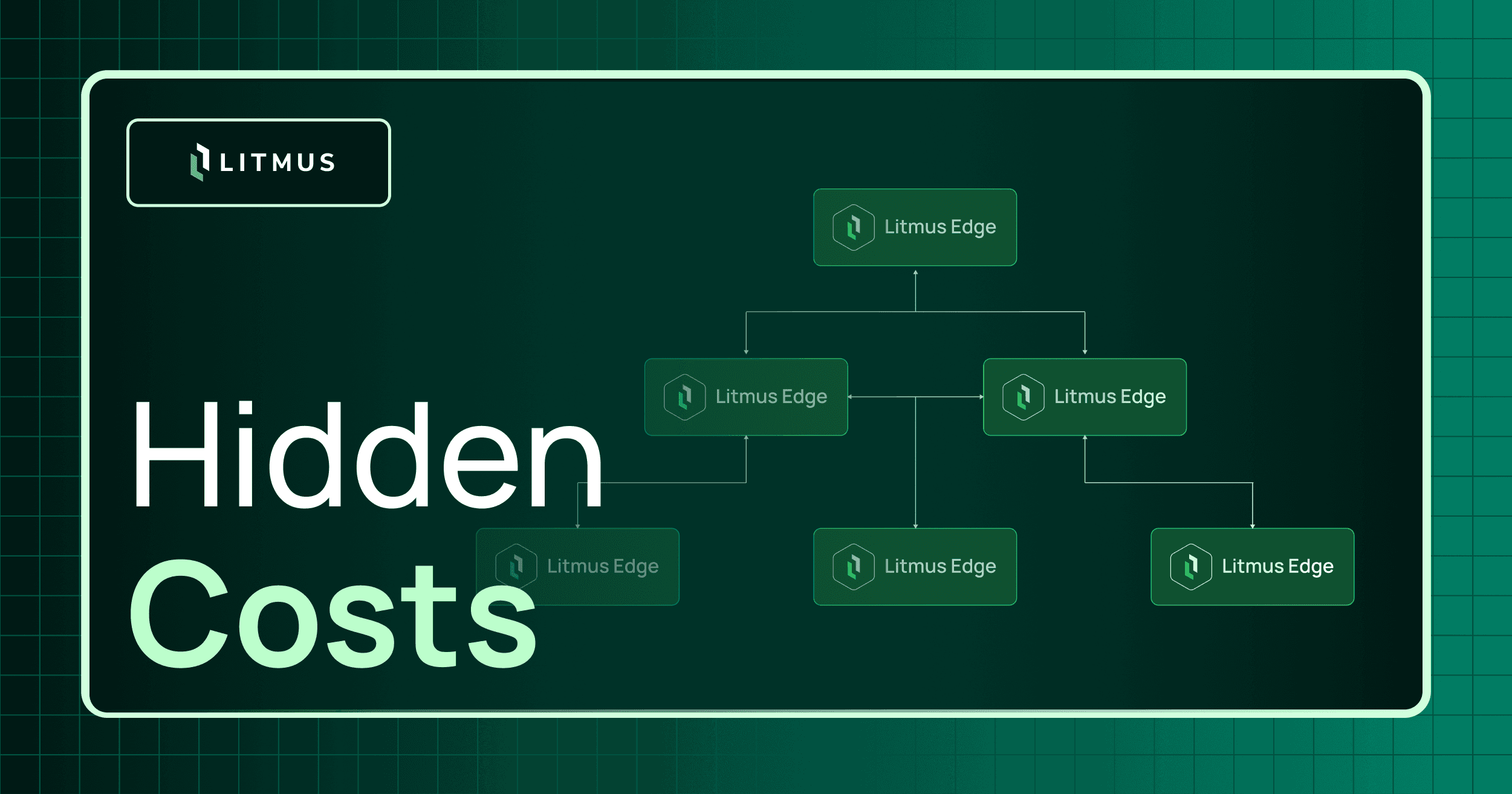
Industrial AI doesn’t need more disconnected pieces. It needs a system that makes data consistent—everywhere it’s used. That’s the difference between something that works once, and something that scales. At Litmus, this is exactly the problem we’re built to solve. A unified industrial data foundation that spans the edge, data pipelines, governance, and execution so that when something works, it doesn’t stay isolated.
When that foundation is in place, you feel the difference almost immediately. Time to value compresses. Data becomes reusable. Use cases don’t just work—they travel across lines, plants, and regions. And teams can spend less time stitching systems together and more time driving outcomes.
Here’s the part that’s easy to miss: The cost of not having a data foundation doesn’t show up as a single line item. It doesn’t hit all at once. It shows up later. In delays that feel small but add up. In work that gets repeated. In projects that never quite make it past where they started. In opportunities that should have scaled, but didn’t. Industrial AI isn’t limited by what’s possible anymore. That part has been proven. What matters now is what can be repeated. What can be scaled. What can actually hold across the enterprise. And that doesn’t start with the model. It starts with the foundation. And most companies are still building on top of something else.
If this is where your team is stuck—trying to scale what already works—it’s time to fix the foundation. Try Litmus Edge for free and see what it looks like to connect, contextualize, and operationalize your data, without rebuilding it every time.