


Since joining Litmus last year, I have had the privilege of discussing strategy with hundreds of operations and IT decision makers, from junior line engineers to CIOs. They universally see the value of a systemwide approach to delivering high-fidelity industrial data into ML and AI platforms that drive factory automation and operational & product innovation.
Most don’t think of it in these terms, but their primary challenge is architectural clarity – knowing how data can be used effectively and then scaling the effective use of that data. They know what is necessary but often not what is possible, which means they don’t know how to design for it.
Consequently, most organizations build their industrial data initiatives without scale and innovation in mind. They begin with a use case: reduce downtime, improve yield, monitor energy, increase throughput. A gateway is deployed. A subset of PLC tags is extracted. A dashboard is built.
But without a clearly defined, enterprise-grade edge-to-cloud reference architecture, data collection remains reactive. Teams collect what they need for today’s problem — not what they will need to optimize the entire production system tomorrow. And without a shared architectural blueprint across OT and IT, every plant becomes a custom project.
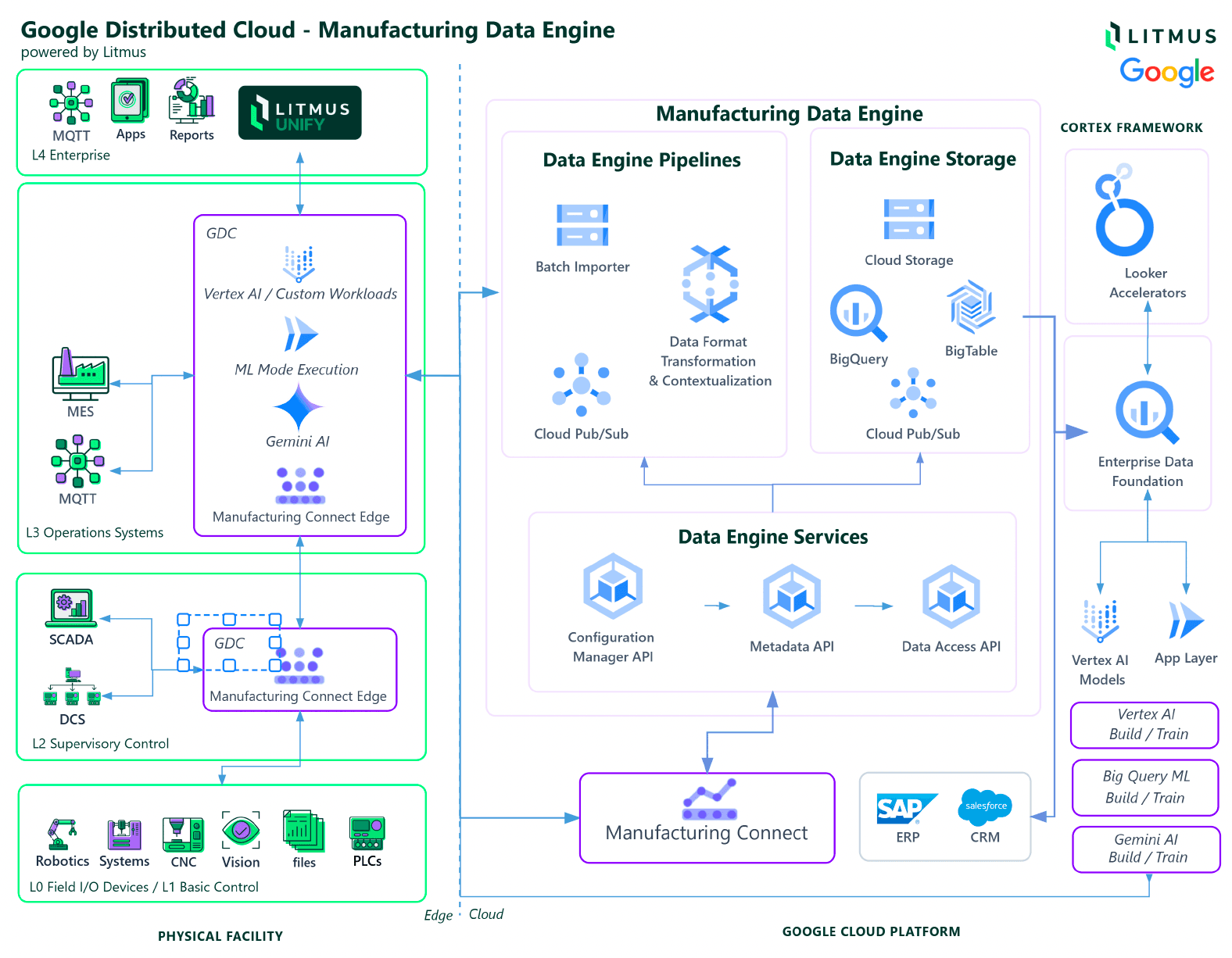
The breakthrough does not happen at the pilot stage. It happens when the organization agrees on an account-wide edge-to-cloud reference architecture — and commits to replicating it across sites. This is the architecture Litmus and Google are delivering through the Google Connected Platform for Manufacturing — an end-to-end solution consisting of Manufacturing Connect Edge from Litmus, Google Distributed Cloud Connected (GDCC), and Google Cloud services.
Most scaling challenges in manufacturing are not technical limitations. They are architectural inconsistencies. When each facility deploys its own edge hardware, connectivity patterns, data models, and cloud integrations, replication becomes exponentially harder.
The difference between stalled pilots and enterprise scale typically comes down to architecture:
Without Architectural Clarity | With Account-Wide Reference Architecture |
Site-by-site customization | Standardized deployment model |
Custom tag extraction per use case | Structured, contextualized data foundation |
Inconsistent security posture | Unified governance and policy enforcement |
Limited cross-site comparability | Enterprise-wide data normalization |
AI pilots trapped in one plant | Repeatable model deployment across facilities |
Scale breakthroughs occur when architecture becomes intentional. When OT and IT align around a common infrastructure pattern — edge, transport, storage, analytics, AI — replication becomes operational rather than experimental. As part of the Google Connected Platform for Manufacturing, Google Distributed Cloud was purpose-built to provide this consistent edge-to-cloud infrastructure across industrial environments.
Google Distributed Cloud Connected provides the infrastructure foundation for a consistent edge-to-cloud architecture deployed directly inside industrial facilities. Manufacturing Connect Edge (MCe) by Litmus operates on top of that infrastructure, providing the industrial data platform layer that connects operational systems and prepares data for enterprise analytics and AI.
As part of the Google Connected Platform for Manufacturing, this architecture brings together Manufacturing Connect Edge from Litmus, Google Distributed Cloud Connected, and a range of Google Cloud services to unify data across manufacturing environments. It enables organizations to apply analytics and AI, including agentic capabilities, where it makes the most sense — at the edge, in the cloud, or in a hybrid model — while maintaining control of their operational environments.
Litmus and Google have built a deep technology and go-to-market partnership to enable this deployment model. Google white-labels the Litmus platform as Manufacturing Connect Edge (MCe), the core industrial data platform application, and Manufacturing Connect (MC), the systems management layer that enables centralized governance and scale across multiple MCe deployments.
Together, we have supported global manufacturers including Bunge, Tyson Foods, Tata Steel, and Jaguar Land Rover in modernizing OT data across distributed operations.
This new solution extends that foundation by integrating the Litmus platform directly into Google Distributed Cloud Connected — bringing cloud-native infrastructure into the plant environment while preserving operational reliability.
Google Distributed Cloud provides the infrastructure layer, while Manufacturing Connect Edge delivers the industrial data platform that operational systems and AI applications depend on. The result is not simply connectivity. It is a validated edge-to-cloud architecture designed for enterprise replication. This approach enables faster time to value with greater simplicity and scalability across manufacturing operations.
Google Distributed Cloud Connected runs like Google Cloud — bringing cloud-native infrastructure directly into your plant environment. Manufacturing Connect Edge by Litmus operates on top of that infrastructure, connecting to PLCs, DCS systems, SCADA platforms, sensors, and field devices. But the differentiator is not connectivity alone — it is the creation of a structured, contextualized industrial data layer that feeds directly into Google’s cloud services:
Manufacturing Data Engine (MDE)
BigQuery, BigTable, Cloud Storage
Pub/Sub
Vertex AI and Gemini
BigQuery ML
AI agents
Looker dashboards and APIs
Instead of asking, “What tags do we need for this use case?” organizations can begin asking:
What variables drive line-level optimization?
How do upstream process signals correlate to downstream quality?
What contextual metadata is required for AI?
How do we ensure consistency across every facility?
Architectural clarity allows manufacturers to think systemically — not tactically.
Industrial AI initiatives often stall not because of model limitations, but because of inconsistent data foundations. When edge architecture mirrors cloud-native constructs, models built centrally in Vertex AI or Gemini can be deployed consistently across distributed sites — without rewriting infrastructure. That enables:
Predictive maintenance across entire fleets
Cross-site performance benchmarking
Energy optimization at network scale
Quality intelligence tied to full-process context
AI agents operating on structured operational data
This is how manufacturers move from isolated experimentation to operationalized intelligence.
Litmus is certified for Google Distributed Cloud across both connected and air-gapped deployments, enabling consistent architecture even in regulated or high-security environments. For OT leaders, this protects uptime and deterministic control systems.
For IT leaders, it enforces standardized infrastructure, governance, and policy management across sites. The same architectural blueprint can be replicated across:
Brownfield facilities
Greenfield expansions
Secure or remote environments
Global plant networks
That consistency is what drives scale.
Many organizations assume scaling requires more technology. In reality, it requires fewer architectural variations.
Within the Google Connected Platform for Manufacturing, a GDC appliance deployed with Manufacturing Connect Edge ensures:
Infrastructure is standardized
Integration with Manufacturing Data Engine is validated
Deployment patterns are repeatable
Governance is centralized
Procurement can be streamlined through marketplace and private offers
Once the reference architecture is defined and agreed upon, scaling becomes an operational rollout — not a reinvention.
This solution is designed for decision-makers responsible for:
Establishing enterprise data strategy
Standardizing industrial edge infrastructure
Scaling AI across distributed operations
Modernizing legacy OT data stacks
Driving systemic operational optimization
If you are evaluating how to align OT and IT around a shared edge-to-cloud architecture, this platform provides a validated foundation to build on.
This solution will be available for live demonstration during the week of April 20th at both Hannover Messe and Google Cloud Next. You can experience it firsthand at the Google kiosk within the Litmus booth at Hannover Messe, as well as at the Google Distributed Cloud booth at Google Cloud Next. If you are evaluating how this architecture applies to your operations, we welcome the opportunity to walk through it with you in person.
Architectural clarity is the catalyst for industrial scale. The Google Distributed Cloud appliance with Manufacturing Connect Edge by Litmus provides a standardized, validated edge-to-cloud reference architecture — ready for replication across your enterprise. If you would like to explore how this approach fits your strategy:
Contact me directly at [email protected]
Reach out to my Google counterpart Jan Poczobutt at [email protected]
Or connect with your Google or Litmus account team
Scale does not begin with more pilots. It begins with architectural alignment.