


Industrial companies are investing heavily in analytics, AI, and lakehouse platforms, but many still struggle with the same first challenge: getting reliable plant-floor data into enterprise data environments in a usable way. Litmus Edge and Databricks help solve this together.
With the Databricks ZeroBus Ingest integration, Litmus Edge can publish contextualized industrial data directly into Databricks Unity Catalog Delta tables. This gives manufacturers a simpler way to move OT data from machines, lines, and plants into Databricks for analytics, reporting, AI, and data engineering.
For companies already using Litmus and Databricks as strategic platforms, this integration strengthens the bridge between industrial operations and enterprise analytics. Litmus Edge prepares and publishes the data at the source. Databricks provides the governed lakehouse environment where that data can be analyzed, modeled, and used across the business.
Industrial data rarely starts in a clean, analytics-ready format. It often comes from PLCs, SCADA systems, historians, robotics, sensors, MES, databases, and custom applications. Each source may use different naming conventions, structures, protocols, and update patterns.
Litmus Edge is built to manage this complexity at the industrial edge. It connects to machines and industrial systems, normalizes OT data, adds context, runs local applications and analytics, and integrates trusted data with cloud and enterprise systems.
The Databricks ZeroBus Ingest integration extends this capability by giving Litmus Edge a direct publishing path into Databricks. Instead of relying on custom scripts, manual exports, or disconnected integration projects, teams can configure Litmus Edge to send selected data streams into Databricks tables. This makes it easier for operations, IT, and data teams to work from the same trusted source of industrial data.
The Litmus Edge Databricks ZeroBus Ingest integration is designed to publish data from Litmus Edge into Databricks. It supports outbound data movement from Litmus Edge to Databricks Unity Catalog Delta tables. In simple terms: Litmus Edge collects and prepares industrial data. Databricks receives that data for enterprise analytics and AI.
A typical flow looks like this: Industrial assets → Litmus Edge → Databricks ZeroBus Ingest → Unity Catalog Delta tables → Analytics, dashboards, and AI
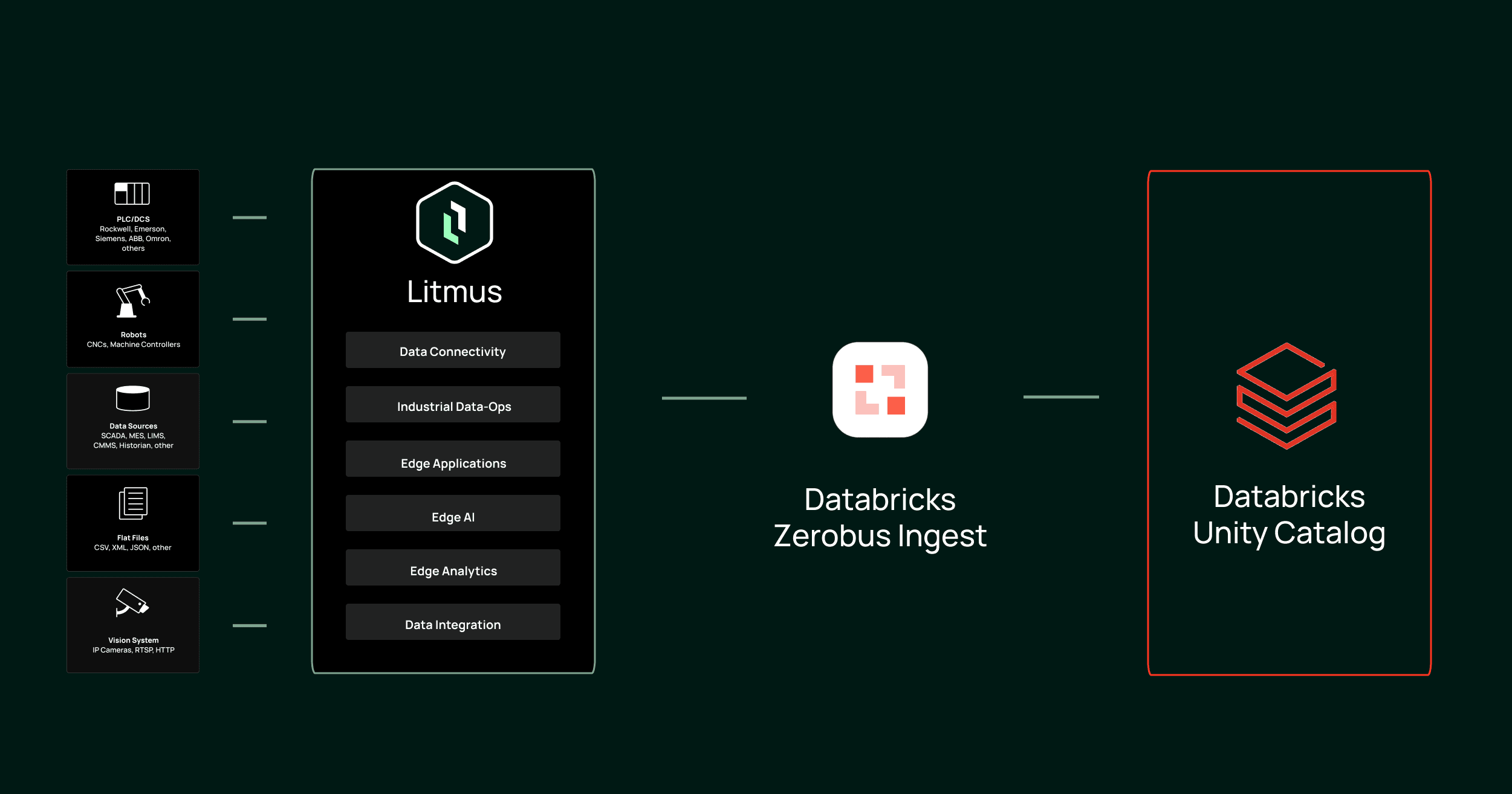
This architecture is straightforward. Litmus Edge handles the industrial side of the pipeline, including connectivity, context, transformation, and publishing. Databricks handles the enterprise data layer, including storage, governance, analysis, and AI workflows.
The value of the integration is not only that data moves from one platform to another. The value is that industrial data becomes easier to use at scale. Manufacturing teams often need to support use cases such as production visibility, predictive maintenance, quality analytics, energy optimization, and AI model development. All of these depend on access to reliable OT data.
Litmus Edge helps create that foundation by turning raw industrial signals into structured and contextualized operational data. The broader Litmus DataOps approach focuses on contextualizing, modeling, orchestrating, sharing, and integrating industrial data so it can be used more reliably across operations, analytics, enterprise systems, and AI workflows.
When that data is published into Databricks, data teams can use it alongside enterprise data to build dashboards, run analysis, train models, and create more scalable industrial AI workflows.
Direct publishing from Litmus Edge to Databricks
The integration provides a configured path for sending selected Litmus Edge data topics into Databricks using ZeroBus Ingest. This reduces the need for custom point-to-point pipelines and helps teams standardize how industrial data reaches the lakehouse.
Designed for Unity Catalog Delta tables
Data is published into Databricks Unity Catalog Delta tables, helping teams align industrial data ingestion with their existing Databricks governance and analytics environment.
Flexible topic-to-table routing
Teams can configure a default destination table and also map specific Litmus Edge outbound topics to specific Databricks tables. This makes it easier to organize data by asset, line, site, data type, or use case.
Support for operational and enriched data
The integration can support standard Litmus Edge tag payloads as well as custom JSON structures from analytics or digital twin workflows, as long as the Databricks table schema matches the payload.
Built for repeatable industrial data pipelines
Once configured, the integration creates a reusable pattern for publishing industrial data from the edge into Databricks. This helps organizations avoid rebuilding one-off pipelines for every plant, line, or analytics project.
A successful lakehouse strategy depends on the quality of the data entering it. Litmus Edge adds value before data reaches Databricks by handling the industrial edge layer. It connects to diverse industrial systems, discovers devices and tags, normalizes data, applies operational context, stores time-series data locally, supports data orchestration, and publishes curated data to enterprise destinations.
This means Databricks users can work with data that is more structured and easier to understand. For example, instead of receiving disconnected raw tag values, data teams can receive information that includes source context such as device, tag, timestamp, value, metadata, or other structured attributes. That makes downstream analytics more useful and reduces the amount of cleanup required after ingestion.
Production Analytics
Litmus Edge can publish machine states, production counts, downtime signals, and performance metrics into Databricks. Enterprise teams can then analyze production performance across lines, sites, and regions.
Predictive Maintenance
Equipment telemetry, alarms, temperature, vibration, and status data can be sent from Litmus Edge into Databricks to support condition monitoring and predictive maintenance models.
Energy Optimization
Energy and utility data can be published into Databricks so teams can analyze consumption patterns by asset, line, production state, or facility.
Industrial AI
Litmus Edge can prepare and publish structured OT data into Databricks for feature engineering, model training, forecasting, anomaly detection, and optimization workflows.
The Litmus product portfolio is designed to create a connected and governed industrial data foundation. Litmus Edge connects and contextualizes data at the source, while the broader portfolio supports centralized management, governed real-time data exchange, metadata discovery, and enterprise-scale industrial data operations.
The Databricks ZeroBus Ingest integration fits into this foundation by extending industrial data from the edge into the enterprise lakehouse.
For OT teams, it provides a practical way to publish plant-floor data without giving up edge control.
For IT teams, it supports a more standardized integration pattern.
For data teams, it makes industrial data available in Databricks for analytics and AI.
For business teams, it accelerates access to operational insight.
Litmus and Databricks address complementary parts of the industrial data journey. Litmus focuses on the edge and industrial data layer: connecting assets, standardizing data, adding context, running local applications and analytics, and publishing trusted data to enterprise systems. Databricks focuses on the lakehouse layer: storing, governing, analyzing, and applying AI to large-scale enterprise data.
Together, they help manufacturers move from fragmented machine data to governed, analytics-ready industrial data. With ZeroBus Ingest, that connection becomes easier to configure, easier to scale, and easier to reuse across industrial data initiatives.
https://docs.litmus.io/litmusedge/databricks-zerobus-ingest-integration-guide
- 1.
What is the Litmus Edge Databricks ZeroBus Ingest integration? It is a Litmus Edge integration that publishes selected industrial data from Litmus Edge into Databricks Unity Catalog Delta tables using Databricks ZeroBus Ingest ingestion.
- 2.
Why is this integration useful? It gives manufacturers a simpler path to move OT data from machines and plants into Databricks, where it can be used for analytics, reporting, AI, and data engineering.
- 3.
What kind of data can be published? Teams can publish machine telemetry, tag values, process data, operational metadata, analytics outputs, and custom JSON payloads when the target Databricks table schema is aligned.
- 4.
Can different data streams go to different Databricks tables? Yes. Teams can use default table mapping or route specific Litmus Edge topics to specific Databricks tables.
- 5.
What are common use cases? Common use cases include production analytics, predictive maintenance, quality analytics, energy optimization, operational reporting, and Industrial AI.
- 6.
Who benefits from this integration? Operations teams, IT teams, data engineers, data scientists, and business leaders all benefit because the integration makes plant-floor data easier to access, govern, and use in Databricks.