
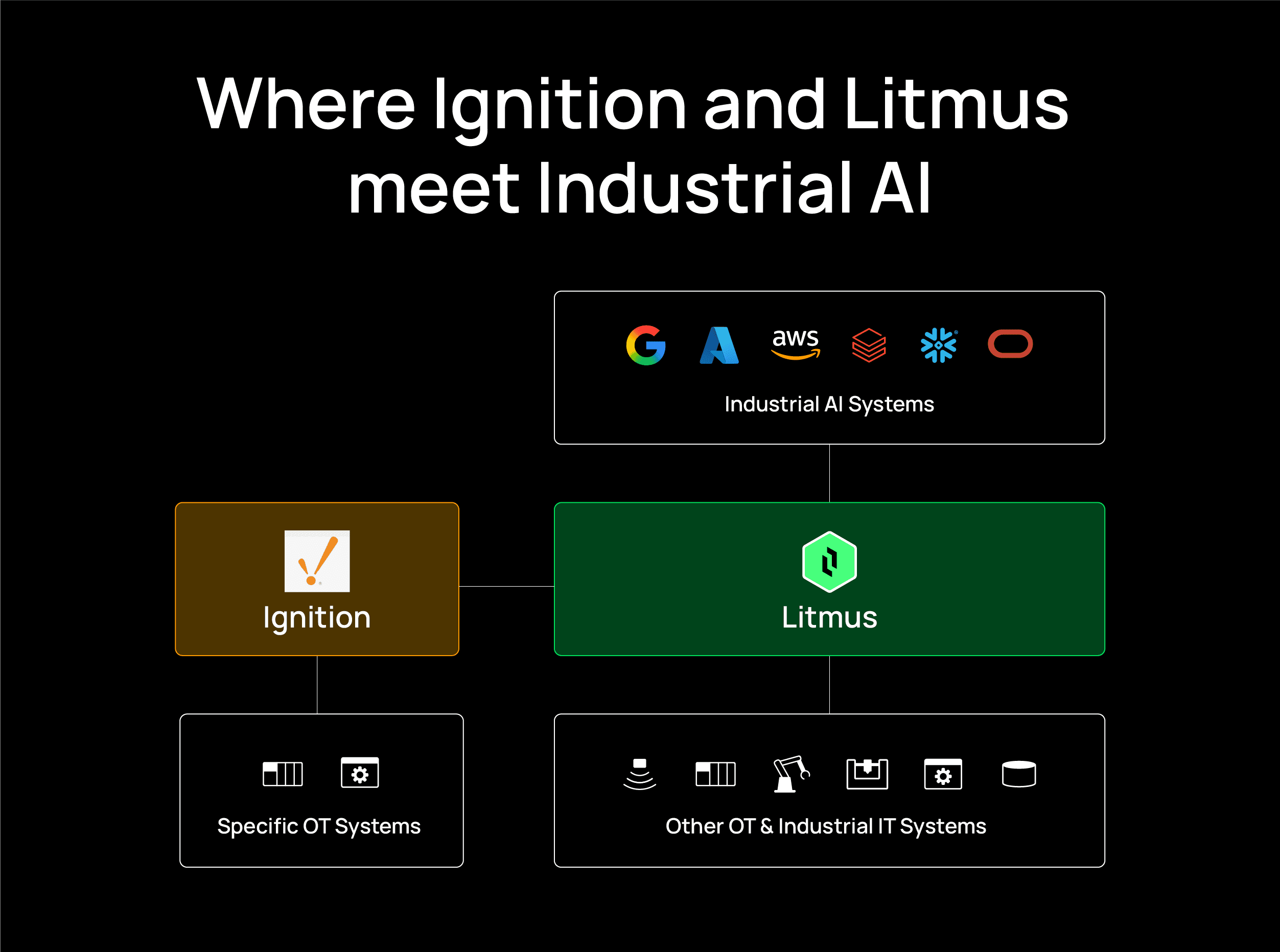


In the modern manufacturing stack, the era of the "all-in-one" monolith is over. The most successful digital transformation strategies today rely on best-of-breed ecosystems where specialized platforms "play nice" together. For years, Litmus co-existed with Inductive Automation’s Ignition to deliver exactly that: a seamless bridge between robust SCADA operations and advanced Industrial AI.
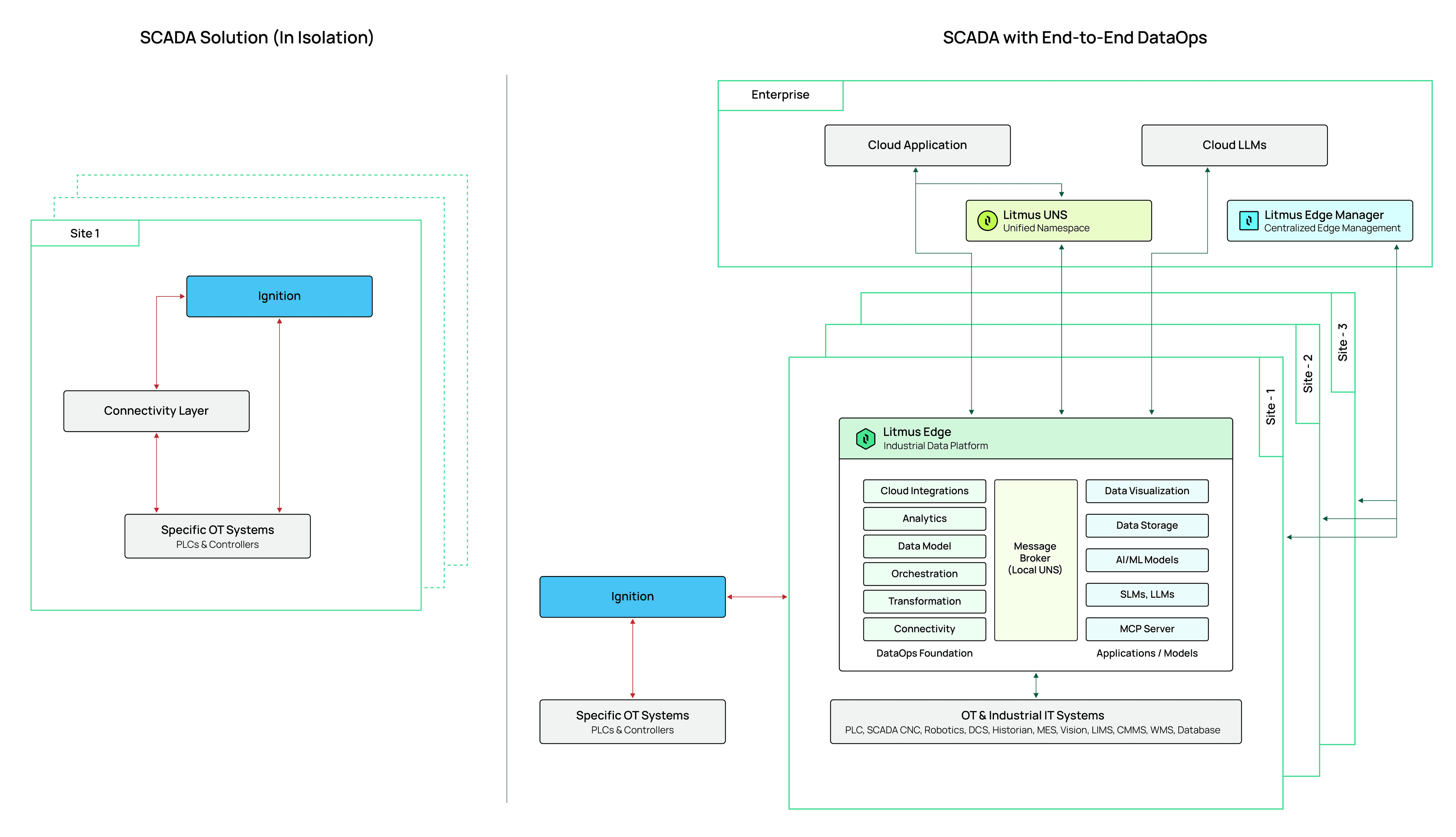
While Ignition provides the essential HMI, SCADA, and alarming layer that operators rely on for daily control, Litmus complements this by acting as the intelligent DataOps and AI layer. We don't replace your SCADA—we amplify it. By unifying our strengths, we enable manufacturers to leverage their existing Ignition data for complex use cases like predictive maintenance, anomaly detection, and vision AI—without burdening the OT/control network.
The integration between Litmus and Ignition has been proven already for our customers. But as demands for Industrial AI grow, this combination becomes even more critical. Data that sits solely in a SCADA historian is useful for looking in the past, but when that same data is fed into Litmus, it becomes predictive. Here is how Litmus leverages Ignition’s data to drive modern AI applications:
Ignition excels at telling you what is happening now. For example, a motor is overheating, or a tank level is low. Litmus takes that data and tells you what will happen next. By ingesting normalized tags from Ignition, Litmus can feed this data into edge-deployed machine learning models. This allows you to detect micro-deviations in asset performance patterns which are invisible to the human eye, shifting your strategy from reactive repairs to true predictive maintenance.
One of the most powerful applications of Industrial AI is Computer Vision. However, a camera alone often lacks context. Is the machine vibrating because it's broken, or because it's running a high-speed recipe? By combining visual data processed by Litmus with real-time process tags from Ignition (such as RPM, temperature, or pressure), we create a "multimodal" AI model. This ensures your analytics see the full picture, dramatically reducing false positives in quality inspection.
The relationship between Litmus & Ignition platform is bidirectional. Litmus doesn't just collect data—it processes complex logic and ML inferences at the edge and can write the results back. This empowers operators with new, AI-driven insights displayed directly on their familiar Ignition HMI screens. It keeps the operator in the loop, armed with better information for faster decision-making.
As Ignition continues to innovate, Litmus evolves right alongside it to ensure these AI workflows remain uninterrupted.
Recently, with the release of Ignition 8.3, the platform has undergone significant structural changes. This is a major leap forward, introducing a new architecture designed for higher speeds and better scalability, qualities that are essential for high-performance AI.
However, in the world of data engineering, when the foundation changes, integrations must adapt. The new architecture introduces a file-based resource system and a new internal historian structure. While these are excellent improvements for performance, they present a challenge for older data collectors that may struggle to interpret the new hierarchy.
We are pleased to share that the Litmus Edge Ignition Module has been updated to Version 3.0.x to fully support these advancements.
We rebuilt key components of our module to ensure "Day 1" compatibility, ensuring that your AI and DataOps pipelines continue to hum along without a glitch.
Handling High-Velocity Data: Ignition 8.3 features a new "Universal Historian" capable of significantly higher data throughput. In the AI world, data volume and velocity are king. We have optimized our internal collectors to handle these higher ingestion rates, ensuring that high-speed record data is captured with full fidelity. This is critical before we normalize it and send it for analytics or storage in the cloud.
Seamless Configuration Mapping: The shift to a file-based configuration system in Ignition 8.3 is a major change. Our updated module specifically understands this new file-based tag path and resource definition. This means that when you browse tags in Litmus Edge, the hierarchy remains accurate and intact, saving you from manual re-mapping work.
Built for Modern DevOps: We are seeing more teams adopt Git-friendly workflows and containerized deployments. The new module is fully validated for these environments, allowing you to host Ignition 8.3 as a Docker container within Litmus Edge itself seamlessly.
Real-world plants rarely run a single version of anything. Some lines may be on legacy SCADA versions, while others move to Ignition 8.3.
Litmus is built for that reality.
Whether you're operating older Ignition deployments or the latest release, Litmus acts as the stable, invisible bridge to keep data flowing, edge analytics running, and cloud pipelines intact. You shouldn’t have to think about the connectivity layer. It should simply work.