
Industrial DataOps & UNS Reference Architecture

Explore the architecture patterns manufacturers use to create trusted, reusable industrial data at scale.

Industrial Dataops & UNS - subpage

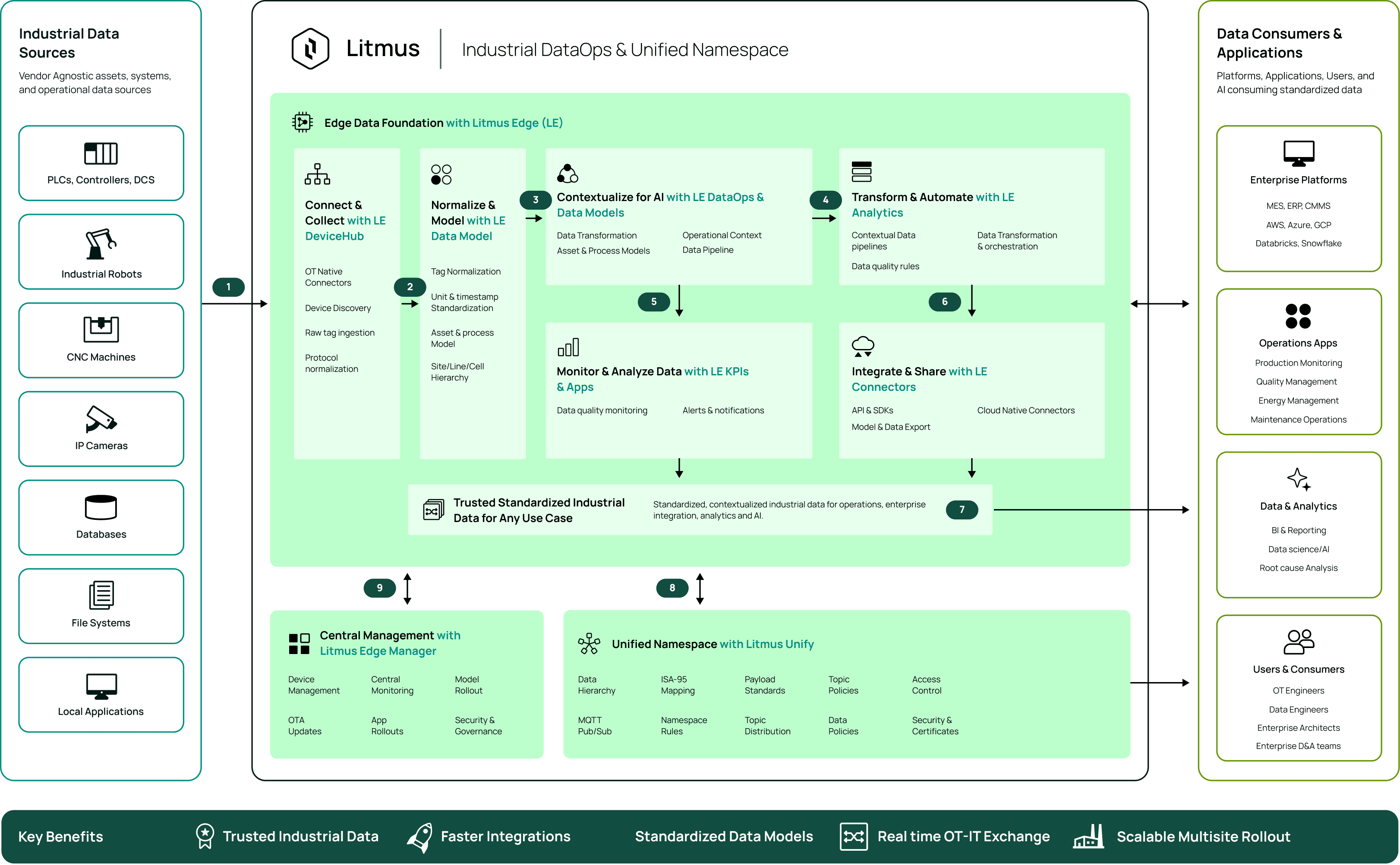
This reference architecture shows how to create trusted, standardized, real-time industrial data by combining Litmus Industrial DataOps with a Unified Namespace foundation for operations, analytics, AI, and enterprise integration.

Architecture Summary

This architecture shows how raw OT and plant data is collected, normalized, modeled, contextualized, validated, and transformed into trusted industrial data products that can be reused across manufacturing use cases.

  • Litmus Edge provides the edge data foundation for connectivity, DataOps, data quality, contextual pipelines, and integration.

  • Litmus Unify provides the Unified Namespace layer for real-time OT–IT data exchange using data hierarchy, ISA-95 mapping, namespace rules, payload standards, topic policies, MQTT-based pub / sub, and secure distribution. 

  • Litmus Edge Manager supports centralized deployment, monitoring, rollouts, and governance, enabling standardized data models and UNS patterns to scale across plants and enterprise environments.

End-to-end data flow

  1. 1.

    Industrial data sources
    Data originates from vendor-agnostic industrial systems such as PLCs, controllers, DCS, robots, CNC machines, cameras, databases, file systems, and local applications.

  2. 2.

    Connect and collect raw OT data
    Litmus Edge DeviceHub connects to industrial assets, discovers devices, ingests raw tags, and normalizes protocols to bring data into the edge data foundation.

  3. 3.

    Normalize and model industrial data
    Raw data is standardized through tag normalization, unit and timestamp alignment, and asset and process models, organized by site, line, and cell hierarchy.

  4. 4.

    Contextualize, transform, and validate data
    Litmus Edge DataOps enriches raw data with operational context, applies transformations, orchestrates contextual pipelines, and enforces data quality rules.

  5. 5.

    Monitor data quality and pipeline health
    Data quality monitoring, alerts, and pipeline health checks ensure downstream systems receive reliable and usable data.

  6. 6.

    Integrate and share standardized data
    Standardized data is shared through APIs, SDKs, cloud-native connectors, and enterprise integration paths.

  7. 7.

    Create trusted standardized data for any use case
    Normalized, contextualized, and validated data becomes trusted, reusable data for operations, analytics, AI, reporting, and enterprise integration.

  8. 8.

    Publish and exchange data through Unified Namespace
    Litmus Unify organizes trusted data into a Unified Namespace using data hierarchies, ISA-95 mapping, namespace rules, payload standards, topic policies, MQTT-based pub / sub, and secure distribution.

  9. 9.

    Manage, govern, and scale the architecture
    Litmus Edge Manager centrally manages devices, monitoring, OTA updates, application and model rollouts, as well as security and governance—enabling DataOps and UNS patterns to scale across sites.

CTA gradient main section