
Industrial AI Reference Architecture

Explore the architecture patterns manufacturers use to transform industrial data into AI-ready operational intelligence.

Industrial AI - subpage

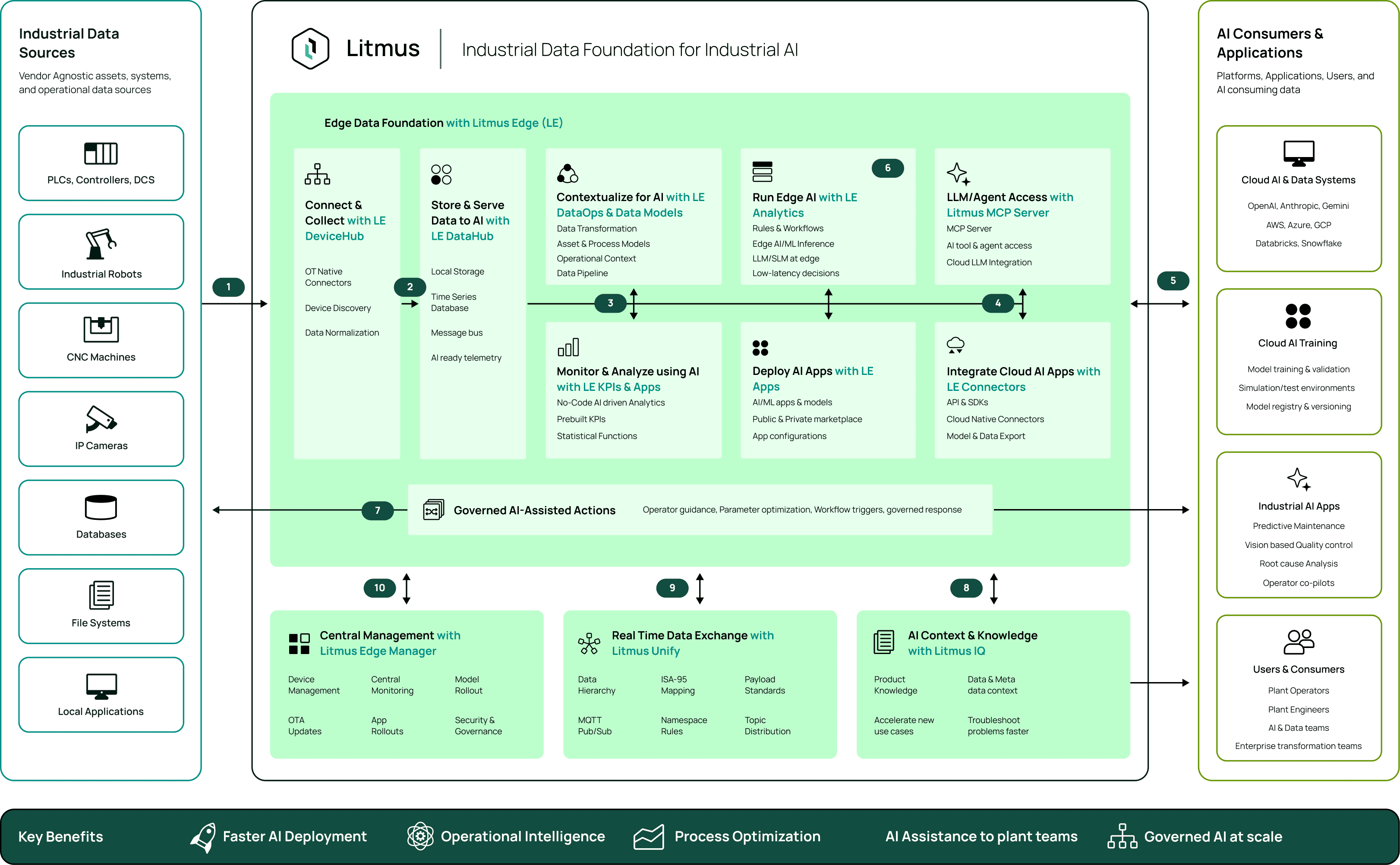
This shows how Litmus enables Industrial AI across edge and cloud by connecting OT data, contextualizing it for AI, training models in cloud platforms, deploying inference at the edge, and enabling AI-assisted decisions across plant and enterprise systems.

Architecture Summary

This architecture shows how industrial data is transformed into AI-ready operational intelligence across edge and cloud environments.

  • Litmus Edge connects OT assets, processes and stores telemetry, and contextualizes data using asset and process models. It enables monitoring and edge inference while integrating with cloud AI platforms for training and model operations.

  • Litmus MCP Server exposes operational context to LLMs and AI agents

  • Litmus Edge Manager supports model rollout and governance at scale

  • Litmus Unify distributes standardized real-time data across systems

  • Litmus IQ provides contextual knowledge to accelerate AI use cases and troubleshooting

The result is a governed Industrial AI foundation supporting predictive maintenance, quality intelligence, root-cause analysis, operator copilots, and process optimization.

End-to-end data flow

  1. 1.

    Industrial AI data sources
    Industrial AI begins with operational data from PLCs, controllers, robots, CNC machines, vision systems, historians, databases, files, manuals, and enterprise systems such as MES, ERP, and CMMS.

  2. 2.

    Connect and ingest industrial data
    Litmus Edge DeviceHub connects to OT assets and plant systems, discovers devices, collects data, and normalizes raw tags, telemetry, and events for downstream AI use.

  3. 3.

    Store, contextualize, and monitor data
    Litmus Edge stores time-series data, serves telemetry, and contextualizes it using asset and process models. This enables AI-driven monitoring, KPIs, and operational analytics.

  4. 4.

    Integrate with cloud AI and LLM services
    Litmus Edge connectors and the Litmus MCP Server integrate industrial context with cloud AI platforms, LLMs, and agent workflows through APIs, tools, telemetry, and historical data access.

  5. 5.

    Train and validate AI models in the cloud
    Cloud AI and data platforms use historical, contextualized data to train, validate, simulate, version, and register models before deployment.

  6. 6.

    Run AI inference at the edge
    Approved AI / ML, LLM, or SLM models run on Litmus Edge for low-latency inference, enabling local decisions, rules, workflows, and operational responses.

  7. 7.

    Trigger AI-assisted actions
    AI insights drive operator guidance, process optimization, workflow triggers, alerts, and governed responses within plant operations.

  8. 8.

    Provide AI context and knowledge
    Litmus IQ supplies product knowledge, metadata context, troubleshooting guidance, and reusable industrial knowledge to improve AI assistance and accelerate new use cases.

  9. 9.

    Exchange real-time AI data
    Litmus Unify standardizes and distributes AI-relevant events, payloads, and operational context using real-time exchange patterns such as MQTT-based pub / sub.

  10. 10.

    Manage AI lifecycle at scale
    Litmus Edge Manager centrally manages devices, monitoring, OTA updates, application and model rollouts, as well as security and governance across distributed environments.

CTA gradient main section