
Data-Driven Smart Manufacturing Reference Architecture

Explore the architecture patterns manufacturers use to standardize, govern, and operationalize industrial data at scale.

Smart Manufacturing - subpage

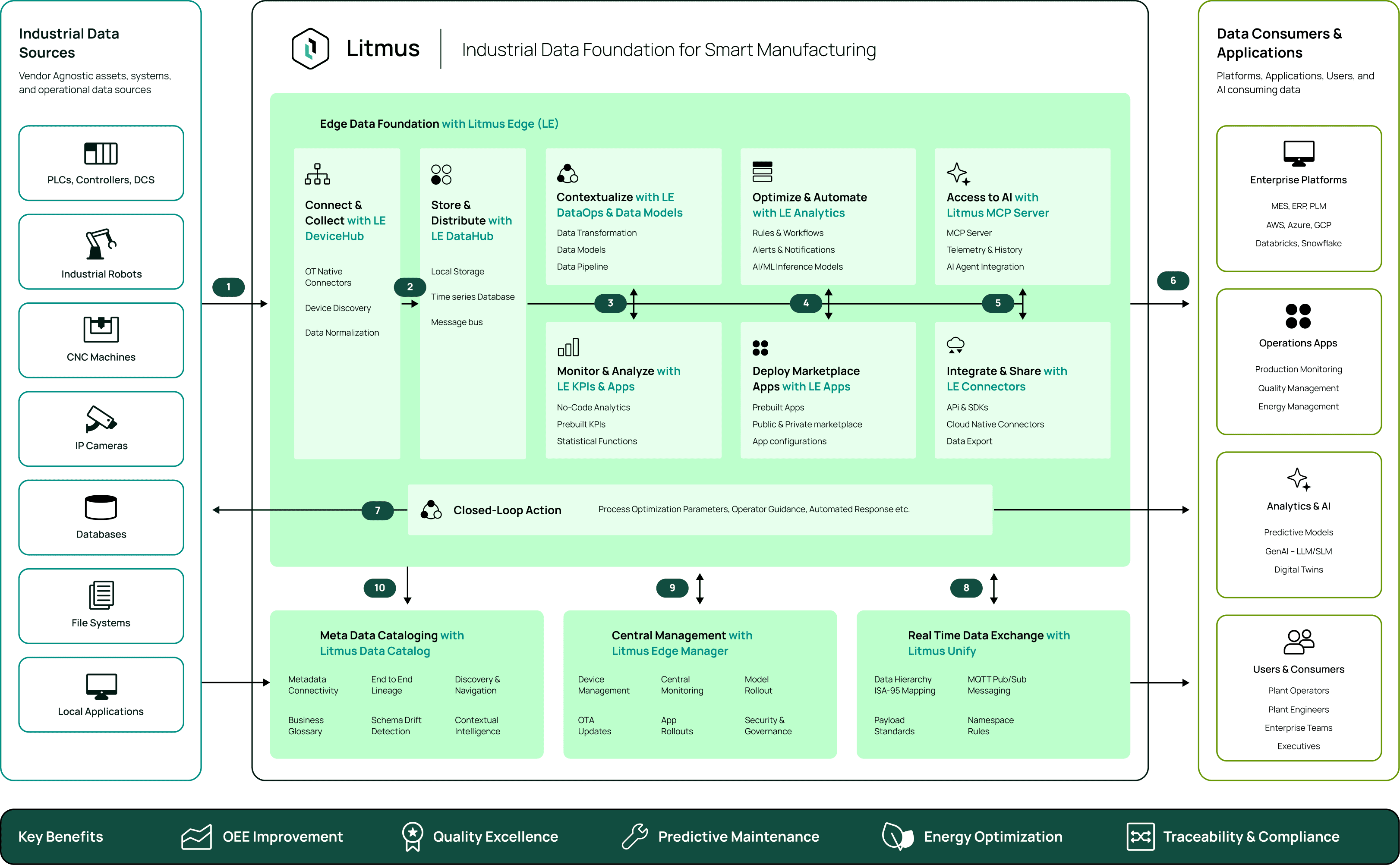
This reference architecture shows how manufacturers connect industrial systems, contextualize OT data, govern real-time data flow, and operationalize insights across edge, cloud, enterprise applications, analytics, and AI.

Architecture Summary

This Data-Driven Smart Manufacturing architecture establishes a repeatable smart manufacturing data foundation that transforms fragmented plant-floor data into standardized, contextualized, governed, and actionable operational data—ready for analytics, automation, and AI.

  • Litmus Edge connects and processes industrial data at the source

  • Litmus Edge Manager standardizes deployment and lifecycle management across sites

  • Litmus Unify enables structured, real-time OT–IT data exchange for enterprise-wide distribution

  • Litmus MCP Server exposes operational context to AI assistants, copilots, and agent workflows

End-to-end data flow

  1. 1.

    Industrial data sources
    Manufacturing data originates from PLCs, controllers, robots, CNC machines, cameras, databases, file systems, and local plant applications, and is fed into the Litmus Edge foundation for collection, processing, and operational use at the edge.

  2. 2.

    Connect, collect, store, and distribute
    Litmus Edge connects to OT assets using native connectors, discovers devices, and normalizes raw industrial data. Data is stored locally, persisted in time-series databases, and made available through the message bus for downstream use.

  3. 3.

    Data transformation, analysis, and monitoring
    Raw data is transformed, modeled, and organized into usable operational context such as assets, processes, and data pipelines. Contextualized data powers no-code analytics, prebuilt KPIs, statistical functions, dashboards, and operational monitoring.

  4. 4.

    Optimize and automate
    Analytics outputs support rules, workflows, alerts, and AI/ML inference. Operational context can also be exposed to AI systems through the Litmus MCP Server. Locally hosted applications can be used to automate workflows.

  5. 5.

    Integrate and share with enterprise systems and AI
    Data is shared with external systems through APIs, SDKs, cloud-native connectors, and data export mechanisms. Integration with LLMs/SLMs is enabled through a secured MCP Server.

  6. 6.

    Data consumers and applications
    Enterprise platforms, operations applications, analytics/AI systems, and users consume the data to improve performance, quality, maintenance, energy efficiency, and compliance.

  7. 7.

    Closed-loop actions
    Insights trigger operator guidance, process optimization parameters, workflow actions, and governed automated responses where permitted.

  8. 8.

    Real-time data exchange with Litmus Unify
    Standardized operational data is exchanged using data hierarchies, namespace rules, payload standards, and MQTT-based pub / sub messaging.

  9. 9.

    Central management with Litmus Edge Manager
    Edge deployments are centrally managed through device management, monitoring, OTA updates, application and model rollouts, as well as security and governance controls.

  10. 10.

    Metadata cataloging
    A centralized data catalog captures industrial data assets with end-to-end lineage, context, and AI-driven insights.

CTA gradient main section